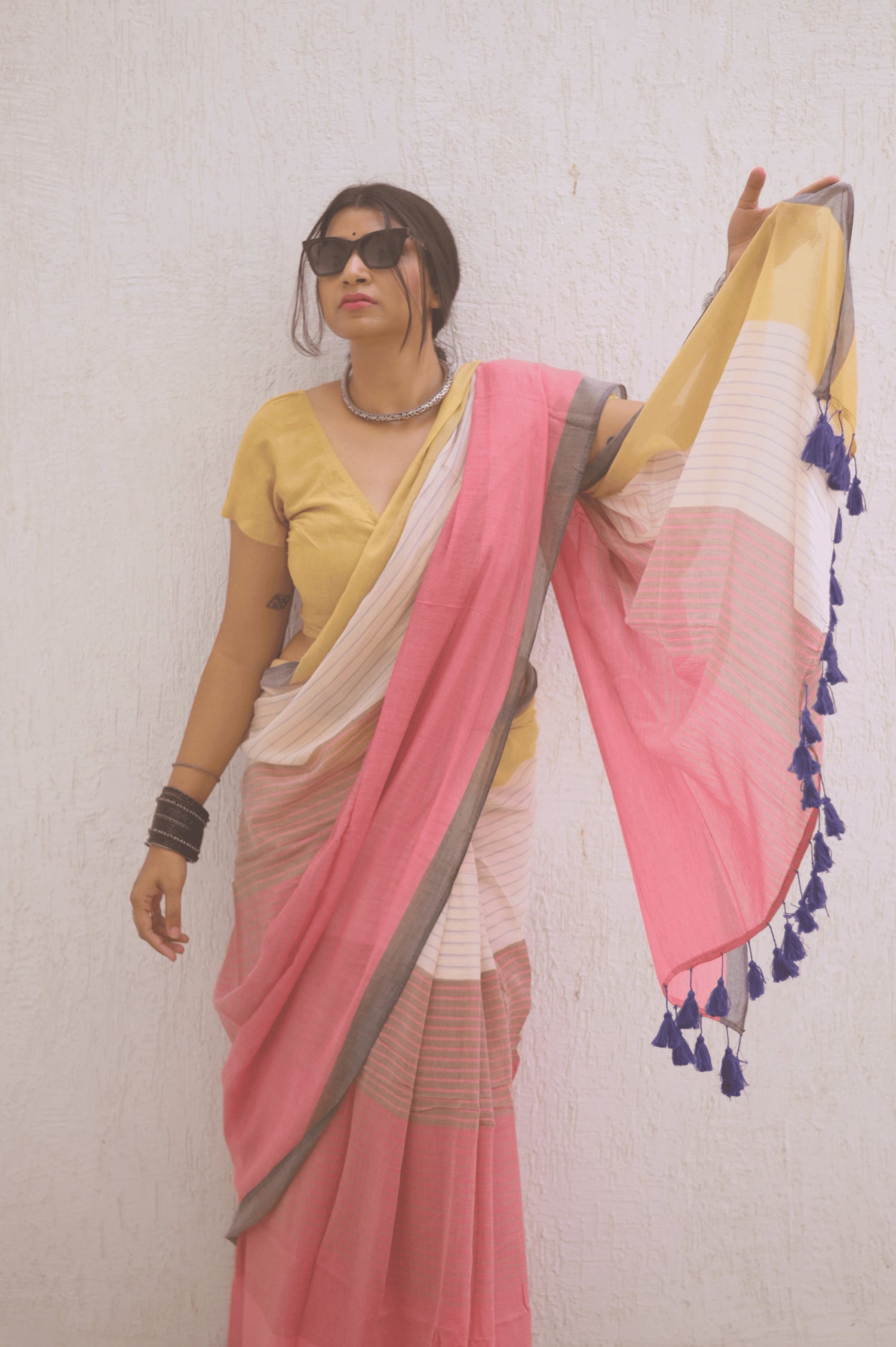


Warli Print Saree: The Art, the Motifs and How to Wear It

A Warli print saree carries the stick figure art of the Warli, an Adivasi community of the northern Konkan in Maharashtra and parts of Gujarat. The look is easy to spot: white figures built from circles and triangles, dancing, farming and fishing on an earthy ground such as red ochre, brown or black. On a saree the art can be painted by hand, block printed, screen printed or digitally printed, and those four routes differ a great deal in feel, price and how long the saree lasts. This guide explains where the art comes from, what the motifs mean, how to tell the methods apart, and how to wear a Warli saree to work or on a relaxed weekend.
What a Warli Print Saree Is
"Warli print" is a shopping phrase, not a weave. It describes any saree whose design borrows the vocabulary of Warli painting: human figures made of two triangles meeting at a point, round heads, line arms and legs, huts, trees, birds and, very often, a ring of dancers. The base can be cotton, mul, khadi, linen, chanderi or silk, and the art can sit on the pallu only, run as a border band, or scatter across the whole body.
Because the phrase covers everything from a one of a kind painted piece to a mill printed saree, the word "Warli" on a tag tells you about the look, not the making. The method is what decides the price and the feel, which is why the middle of this guide spends time on telling them apart. If you are new to the wider family of painted and printed sarees, our guide to printed sarees covers every print type, and the hand painted saree guide covers brush work on fabric in depth.
The Warli Community and Its Painting
The Warli live mainly in the hills and coastal belt north of Mumbai, around Dahanu, Talasari, Jawhar, Palghar and Mokhada, with communities across the border in Gujarat. Their painting began on the walls of their own homes, not on cloth. Women traditionally did the painting, and walls were painted during the harvest and wedding seasons.
The materials were what the household had. Walls were smoothed with mud and cow dung, giving a warm brown or red ochre ground. The white came from rice flour mixed with water and a little gum, applied with a bamboo stick chewed at one end to make a brush. Red and yellow dots were sometimes added, but the classic look is white alone. That is why the most faithful Warli sarees today keep to white or off white on a single earthy colour.
At the heart of a wedding painting is the chauk, a square that encloses Palaghata, the goddess of fertility. By custom, a married woman still draws its first line, and the rest may be completed by other artists. The square is surrounded by scenes of daily life: sowing, harvest, fishing, hunting, festivals and dance.
From the 1970s the art began to travel. The work of Warli artist Jivya Soma Mashe of Dahanu taluka, painted on paper and canvas rather than walls, drew a wide audience. He received the Padma Shri in 2011. In 2014 Warli painting was registered as a geographical indication, with a community organisation from Dahanu taluka as the registered proprietor. The registration covers clothing and textiles among other product classes.
Reading the Motifs
Warli art uses a small set of shapes and builds everything from them. Once you know the shapes, you can read almost any Warli saree, and you can also spot designs that use the name but not the grammar.
The tarpa dance is the motif people recognise most. The tarpa is a long wind instrument. In the dance, a player stands at the centre while men and women link hands and move in a circle around him, never turning their backs on him. In common descriptions, he also signals when the circle should turn clockwise or the other way. On a saree it appears as a spiral or ring of linked figures, often with a small figure in the middle holding a long curved instrument.
A useful check: in traditional Warli work, figures and patterns do not overlap, and fields, rivers and forests sit in clearly separate spaces. Designs that crowd figures on top of each other, or add shading and outlines in many colours, are using the idea of Warli loosely.
Hand Painted, Block, Screen or Digital
The same dancing figures can reach a saree by four quite different routes. Each has a fair place. The point is to know which one you are buying and to pay accordingly.
Hand painting is the closest to how Warli was first made, and on a good piece you can see the artist working out each scene. Block printing is a separate Indian craft with its own skill, explained in our hand block print saree guide. Screen and digital printing make the look affordable and very consistent, which suits a saree you plan to wear often and wash at home.
How to Tell Painted From Printed
Sellers do not always label the method clearly. These checks work in a shop and, with good close up photos, online too.
Fabrics That Suit Warli Work
Warli art reads best on a base with a matte surface and a solid, earthy colour, because the white figures need contrast. The base also decides how the saree drapes and how you will look after it.
For a first Warli saree, cotton is the sensible start. It breathes, it suits the art, and it is easy to drape. Our guide to types of cotton sarees explains the differences between mul, khadi and other cottons, and the mul cotton guide covers the softest of them.
Styling for Office and Casual Days
Warli is graphic and busy, so the rule is simple: let the art lead and keep everything else quiet. Pick one strong neutral or one earthy colour from the saree for the blouse and accessories.
Blouse colour does most of the work. A red ochre Warli saree is easy with black, ivory or mustard. A black base takes rust, red or off white. A white or cream base pairs well with indigo, brick red or dark green. For cuts, our blouse designs for cotton sarees guide has front and back ideas that suit printed cotton too. Avoid adding another loud print to the blouse at the office, and skip heavy gold, which competes with the white figures.
For more cotton day looks, see our cotton saree styling guide, and browse office wear sarees for calm bases that pair well with a Warli blouse.
Buying With Respect for the Community
Warli art belongs to a real community, and many artists depend on it for income. Buying a printed Warli saree is not wrong, but a few habits keep the exchange fair.
Other Indian folk traditions follow similar patterns of hand work and mill copies. Our Kalamkari saree guide covers painted and block printed Kalamkari, and the Kutch embroidery guide covers another community craft.
Caring for a Warli Saree
Care depends on two things: the base fabric and the method. Always follow the label first. When there is none, these rules are safe.
For fabric by fabric detail, see our guide to washing cotton, chiffon and linen sarees. Store a painted saree folded with a soft muslin cloth between the folds, and refold it along new lines every few months so the paint does not crack at the creases.
Sarees in This Guide
None of these sarees is a Warli saree. They are a lighter alternative in the same spirit: hand painted designs on soft bases, and calm cotton and linen that carry a Warli blouse well. Apricot Bloom and Anthuria are hand painted mul cotton, with no blouse piece, and are dry clean. Frangipani is a hand painted chiffon with a 1 m crepe blouse piece, dry clean. Corner Office is pure handloom linen at ₹4,499 with a 1 m blouse piece, dry clean. After Dark and Bright Side are plain mul cotton with no blouse piece and take a gentle cold hand wash, and both work as a quiet base for a Warli printed blouse. Every MAYIN saree is 5.5 m long and 45 inches wide. Browse more in hand painted sarees.
 Apricot BloomBeige handpainted mul cottonPair with Black, rust
 AnthuriaMint green handpainted mulmul cottonPair with White, teal
 FrangipaniBeige floral hand painted chiffonPair with Maroon, ivory
 Corner OfficeMulticolour checked pure handloom linenPair with Navy, white
 After DarkPlain black mul cottonPair with Rust, ivory
 Bright SideWhite mulmul cotton with yellow borderPair with Navy, mustard
Questions People Ask
What is a Warli print saree?
It is a saree decorated with the motifs of Warli painting, the art of the Warli community of Maharashtra and Gujarat. The art can be hand painted, block printed, screen printed or digitally printed.
Which state is Warli art from?
Maharashtra, mainly the Palghar and Thane region around Dahanu, Talasari, Jawhar and Mokhada, with Warli communities in parts of Gujarat too.
What do the triangles and circles mean in Warli art?
Circles stand for the sun and moon, triangles for mountains and pointed trees, and squares for a sacred enclosure or land. Two triangles joined at the tip form a human or animal body.
What is the tarpa dance in Warli painting?
It is a dance in which men and women link hands and circle around a player of the tarpa, a long wind instrument. In paintings it shows as a ring or spiral of linked figures.
Does Warli painting have a GI tag?
Yes. Warli painting was registered as a geographical indication in 2014, and the registration covers clothing and textiles among other products.
How can I tell if a Warli saree is hand painted?
Compare two figures: hand painted ones differ slightly in shape and line. Printed figures are identical and repeat at a fixed interval.
Is a Warli saree good for office wear?
Yes, a cotton or linen Warli saree with the art on the pallu or border works well. Pair it with a solid blouse and small silver jewellery.
Which blouse goes with a Warli saree?
A solid blouse in black, ivory, rust, mustard or the ground colour of the saree. Keep prints to one piece.
Which fabric is best for a Warli saree?
Cotton, mul and khadi are closest to the original matte wall look and the easiest to wear. Chanderi and silk suit dressier occasions.
How do I wash a Warli painted saree?
Dry clean is safest for hand painted work. If the label allows washing, use cold water, a mild detergent, no scrubbing, and dry it inside out in shade.
Can I paint Warli on a plain saree myself?
Many people do, using white fabric paint on a dark cotton base. Learn the meaning of the motifs first, and avoid using the sacred chauk as decoration.
Who made Warli art famous?
Warli artist Jivya Soma Mashe brought the art to a wide audience from the 1970s, and received the Padma Shri in 2011.


