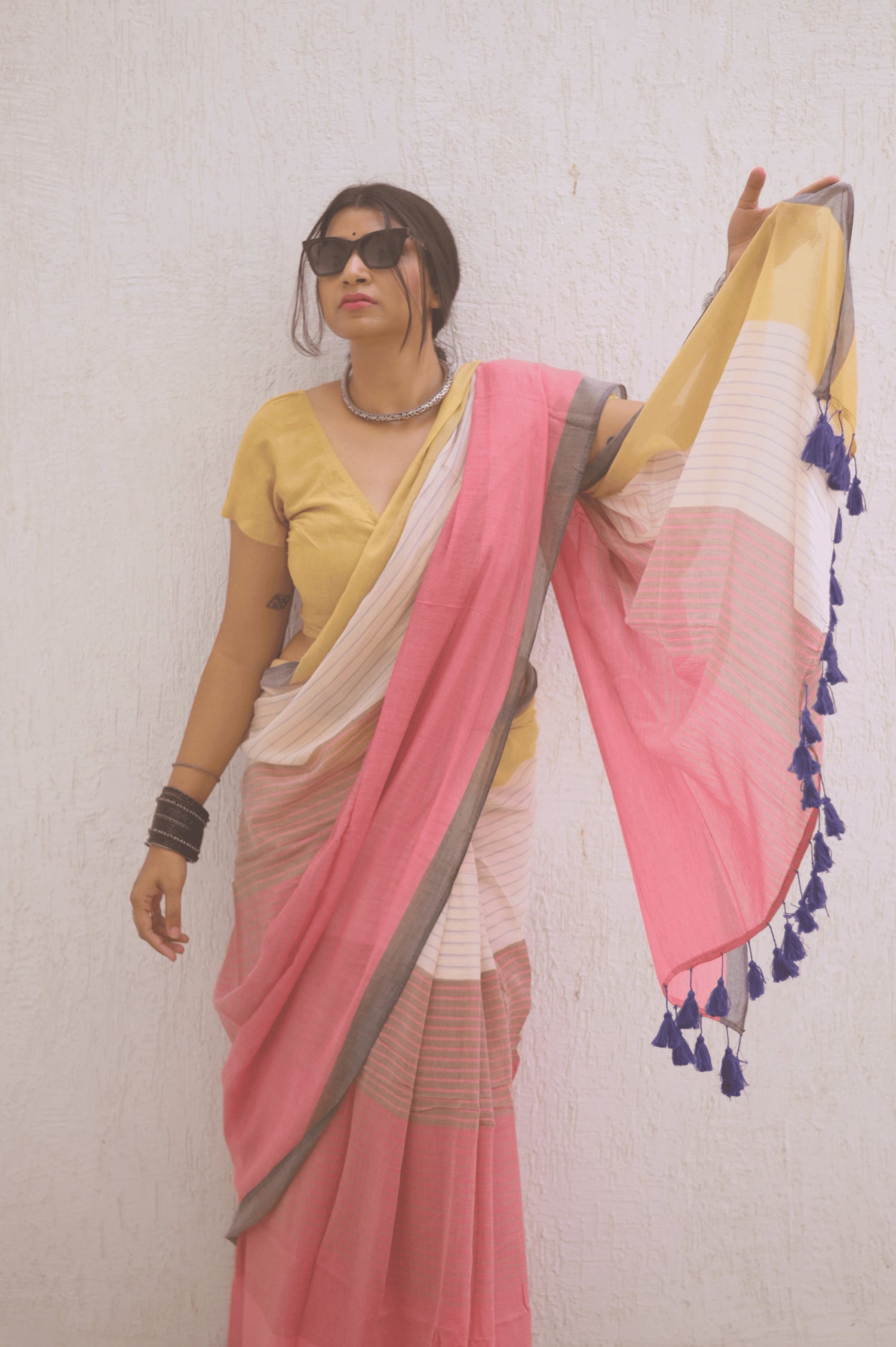


Traditional Blouse Designs: Six Classic Cuts, Regional Styles and a Tailor Brief

A traditional blouse design is a fitted blouse with a modest neckline, sleeves to around the elbow and a detail taken from the saree itself, usually the border, the zari or a woven motif. Six cuts cover most traditional looks: elbow sleeves with a border, a high back with a dori and latkans, a boat neck edged in zari, a round neck with potli buttons, the choli cut and a temple border yoke. This guide explains each one with rough measurements, then the regional blouses of Bengal, the South, Gujarat and Maharashtra, which sarees and occasions suit each design, and a brief you can hand to your tailor.
Six Traditional Designs and What They Share
Traditional does not mean one fixed pattern. It means a blouse that lets the saree lead: the cut is fitted and covered, and the decoration repeats something already in the saree. The stitched blouse as most of India wears it today is younger than many people think. It was promoted in Bengal in the second half of the nineteenth century, together with the petticoat and front pleats, as a new way of wearing the saree, and that way spread across the country. Older fitted bodices, the choli among them, are far older and still shape the designs below.

All measurements here are approximate. There is no national standard for blouse cuts, and every tailor works slightly differently, so treat the numbers as a starting point to discuss, not a rule.
Elbow Sleeves With a Border
This is the blouse most people picture when they hear the word traditional: a round or boat neck, a sleeve ending at or just above the elbow, and a band of the saree border, or a strip of zari, at the sleeve hem. It suits silk, cotton and linen sarees with a woven border, and it flatters most arms because the sleeve ends at a narrow point.

The border is usually cut from the blouse piece or the end of the saree. Before cutting, check you have enough: two elbow sleeve hems take very roughly 0.7 m of border once seams are added. MAYIN's guide to pattu saree blouse designs goes further into matching sleeve length to border width, and into maggam work on sleeves, so it is not repeated here.
High Back With Dori and Latkans
A high back closes near the base of the neck, about 1 to 3 inches below the shoulder line, which makes it one of the most covered blouse backs. Because a high back cannot be pulled over the head, it needs an opening. The traditional answer is a keyhole: a small teardrop or round opening at the centre back, closed at the top with a hook or a button and tied with a dori, a cord whose ends carry latkans, the small hanging tassels or ornaments.

A high back suits older relatives, pujas and long ceremonies, and it pairs well with a lower round neck at the front. If you prefer a deeper back with a dori, MAYIN's guide to blouse back neck designs covers depths and fixes for gaping, and the batch guide to latkan designs compares tassel types and how to attach them.
Boat Neck With Zari
A boat neck runs wide and shallow from shoulder to shoulder. A classic boat is about 8 to 9 inches across and 2 to 4 inches deep, and the back usually matches it. Edging that line with zari, a woven border or zari piping turns a plain blouse into a festive one, and the wide neckline gives the work room to be seen.
Two cautions. A wide neck uses up shoulder seam, so on narrow or sloping shoulders keep the width nearer 8 inches and ask for strap holders inside the shoulders. And a wide band of stiff zari against the neck can scratch, so ask for it to be faced or lined on the inside. The full guide to boat neck blouse designs covers widths, backs and bra straps in detail.
Round Neck With Potli Buttons
Potli buttons are small, round, fabric-covered buttons that look like tiny potli pouches, which is usually given as the reason for the name. Each one sits in a narrow fabric loop, called a rouleau loop. A row of them down the front opening of a round neck blouse is one of the oldest and plainest ways to fasten a blouse, and it reads as traditional without any zari at all.

Potli buttons also work at a high back, at the cuff of an elbow sleeve or at a keyhole. On a cotton or linen saree they are often the only decoration the blouse needs.
The Choli Cut
The choli is the old fitted bodice of India, usually cut short so the midriff shows and fastened at the front or back with hooks or cords. Many cholis have shaped cups, some have bare backs held by ties, and in Gujarat and parts of Sindh a related bodice, the kanjari, is cut square without cups and tied with cords. In Kannada the saree blouse is called a ravike.
When a tailor offers a "choli cut" for a saree blouse, it usually means a front built in two parts: shaped panels over the bust, made with gathers, darts or cups, sewn to a firm band that runs under the bust. That seam is what makes the choli fit closer than a plain darted blouse. It is the same idea as the band in a katori blouse, which MAYIN covers in the guide to princess cut and katori blouses.
A choli cut needs a careful trial, because a band that is a little tight shows at once. The batch guide to the choli cut blouse covers its pieces and measurements in detail.
Temple Border Yoke
A temple border is a row of triangular motifs, a stylised version of the gopuram, the tower over a South Indian temple gateway. It is most closely associated with Kanjivaram silk, though it appears on other southern silks and on cotton sarees too. A temple border yoke takes a strip of that border and sets it round the neckline, so the triangles point down from the neck like a necklace.
A woven border on the blouse piece is the neatest source. If the saree has none to spare, a matching border bought by the metre works, but match the zari colour, antique or bright gold, to the saree in daylight first. For blouses with brocade rather than a border, see Banarasi blouse designs.
Regional Traditional Blouses in Brief
Each region has its own idea of a traditional blouse, and borrowing one detail is often enough to give a look its regional feel. For the full regional look, with jewellery, bindi and hair, see the guide to the traditional saree look.
Bengali
The classic pairing is a red blouse with a white saree that has a red border, usually with elbow or three-quarter sleeves and a round or boat neck. In late nineteenth century Bengal, frills, lace and a brooch were part of the look, and a frilled cuff is still a nice nod to it. The Bengali saree look guide covers the drape and the red and white saree.
South Indian
Silk sarees in the South usually take a contrast blouse in the border or pallu colour, with the border on elbow sleeves and a neckline that leaves room for temple jewellery. The temple border yoke and heavy maggam work belong here too. The pattu saree blouse designs and silk saree blouse designs guides go into this in depth.
Gujarati
In the seedha pallu drape the pallu comes forward over the right shoulder and spreads across the front, so the sleeves and the back of the blouse show more than the front. That is why Gujarati blouses often put their work on the sleeves and back. For garba and festive wear, mirror work and the tied, cupless kanjari carry the older bodice into the present.

Maharashtrian
With the nauvari and the Paithani, the traditional blouse is usually fitted with elbow sleeves, often edged in the saree border. A distinctive choice is khun, also called khana: a woven blouse fabric from north Karnataka with small, glossy motifs, worn with Ilkal sarees in north Karnataka and in parts of Marathwada and Vidarbha. Guledgudd khana carries a GI tag. The Marathi bridal look guide covers the bridal version.
Which Sarees and Occasions Suit Each Design
Match the blouse to the weight of the saree first, then to the day. A heavy silk carries zari and border work; a light cotton wants a lighter touch, such as piping, potli buttons or a narrow border at the sleeve.
MAYIN keeps a collection of traditional sarees with zari borders and handloom weaves that take these blouse designs well.
A Tailor Brief for a Traditional Blouse
Take the saree, the blouse piece and, if you have one, a blouse that already fits you well. Show the tailor the drawing above and point to the design you want, then settle each item below before any cutting. The guide to blouse measurements and fitting explains how each measurement is taken.
Sarees in This Guide
These MAYIN sarees have the zari borders and handloom weaves that suit a traditional blouse. On Repeat and Composure are pure handloom linen with a zari border at ₹4,499, each with a 1 m blouse piece, which usually covers a short sleeve blouse with a zari piped neck; ask your tailor before planning elbow sleeves. Manjari (₹2,299), Emerald, a green striped mul cotton zari saree (₹2,099), and Siyaahi (₹2,199) come without a blouse piece and suit a contrast blouse with potli buttons or a zari piped boat neck. The Miss Earth Tissue Saree (₹3,499) wants a lined blouse, and Lilac Bloom, an Original Dhakai Jamdani (₹4,999), suits a plain round neck with potli buttons. All of these are dry clean. Bright Side, white mulmul cotton with a yellow border (₹1,999), takes a gentle cold hand wash and pairs with a yellow or red blouse with elbow sleeves. Delivery is free in India on orders of ₹2,000 and above.
 On RepeatYellow handloom linen with zari borderPair with Maroon, bottle green
 ComposurePink pure handloom linen with zari borderPair with Maroon, gold
 ManjariRed striped mul cotton zariPair with Gold, bottle green
 EmeraldGreen striped mul cotton zariPair with Maroon, mustard
 Miss Earth Tissue SareeMiss earth tissuePair with Maroon, emerald
 Lilac BloomLavender floral original dhakai jamdaniPair with Purple, cream
 SiyaahiMulticolour striped mul cotton zariPair with Black, gold
 Bright SideWhite mulmul cotton with yellow borderPair with Yellow, red
Questions People Ask
Which blouse design is best for a traditional saree?
A fitted blouse with a round or boat neck and elbow sleeves edged in the saree border suits almost any traditional saree. Add one more detail, such as a dori back or potli buttons, and stop there.
What is the traditional sleeve length for a saree blouse?
Elbow length, about 10 to 12 inches from the shoulder point, is the classic traditional choice. Short sleeves are common in hot weather, and three-quarter sleeves suit Bengali and winter looks.
What is the difference between a choli and a blouse?
A choli is the older fitted bodice, often cut short with shaped cups and fastened with hooks or ties. A saree blouse is the stitched top most women wear today, and many are cut in a choli style.
What is a choli cut blouse?
It is a blouse whose front has shaped panels over the bust sewn to a band under the bust. The seam gives a closer, more supportive fit than a plain darted blouse.
What are potli buttons on a blouse?
Small round buttons covered in fabric, each fastened through a narrow fabric loop. They are used down the front, at a high back or at a keyhole, and are often paired with hidden hooks.
What is a temple border on a blouse?
A band of triangular motifs based on the towers of South Indian temples, taken from the saree border. On a blouse it is usually set round the neckline or at the sleeve hem.
How do I use the saree border on my blouse?
Ask the tailor to cut it from the blouse piece or the saree end and place it at the sleeve hem, the neckline or both. Two elbow sleeve hems need very roughly 0.7 m of border.
Can a traditional blouse have a deep back?
Yes. A deep U or V back with a dori and latkans is common at weddings. Keep the front neck higher so the blouse still looks traditional.
How much fabric do I need for a traditional blouse?
About 1 m covers most short sleeve designs. Elbow sleeves, a cut border or a choli cut usually need more, so check the amount with your tailor first.
Which blouse goes with a Bengali saree?
A red blouse with elbow or three-quarter sleeves and a round or boat neck is the classic choice with a white and red saree.
What blouse is worn with a nauvari saree?
Usually a fitted blouse with elbow sleeves, often edged in the saree border. Khun fabric, a woven blouse material from north Karnataka, is a traditional choice in parts of Maharashtra.
Traditional saree ke liye kaun sa blouse design achha hai?
Round ya boat neck aur elbow tak ki sleeves, jinke hem par saree ka border laga ho, sabse traditional lagta hai. Peeche dori ya potli buttons bhi achhe lagte hain.


