

Manthrakodi Saree: Meaning, Colours, Weaves and Price

A manthrakodi is the new, blessed saree that the groom places over the bride's head during a Kerala wedding, as a sign that he will protect and care for her. The word comes from "manthra", blessed, and "kodi", new cloth. The named rite belongs to the Kerala Christian wedding, where the priest blesses the saree and threads from it are often used for the cord of the thaali. At Kerala Hindu weddings the groom also gives the bride a new saree during the ceremony, a custom with older roots in the giving of a pudava, and families often call that saree the manthrakodi as well. This guide explains the meaning, the colours, the weaves, what one costs as of 2026, and how to keep it for a lifetime.
What a Manthrakodi Is
In the wedding service of the Syro-Malabar church, the priest blesses the manthrakodi with a prayer and sprinkles it with holy water. After the groom ties the thaali, the priest hands him the manthrakodi and he places it over the bride's head. The service book explains the gesture through the story of Rebecca, who covered herself with a veil when she met her husband. Other descriptions of the rite read it more simply: the groom's first gift to his wife, and his promise to look after her.
So a manthrakodi is not a particular weave. It is a role a saree plays. It can be a cotton kasavu, a tissue, a silk with zari or a silk cotton, in cream, gold, red or another colour the family prefers. What makes it a manthrakodi is that it is new, given by the groom's side, and blessed or presented at the wedding itself.
Which Communities Follow It
The manthrakodi as a blessed rite is a custom of the Saint Thomas Christians of Kerala. It is part of the Syro-Malabar service, it is central to Knanaya weddings, and Orthodox services are also described as including a saree from the groom's family draped over the bride's head. Families from these churches in the Gulf, the UK, North America and Australia usually keep the custom too, and often buy the saree in Kerala.
Kerala Hindu weddings have their own version, without the church blessing. In the older Nair form of marriage, sambandham, the central act was the giving of cloth, called pudava koda or pudamuri: the groom handed the bride a pudava, a length of cloth, in front of a lit lamp, with relatives as witnesses. Today most Hindu weddings in Kerala are short ceremonies, often an hour or two, centred on tying the thali, and the groom, often handed the saree by his father, gives the bride a new saree as part of the rite. That saree is also widely called the manthrakodi, or simply the pudava. Some sellers use the word even more loosely, for any Kerala wedding saree.
Customs differ between parishes, castes and families, and they change over time. If you are planning a wedding, ask the elders on both sides what they expect, and ask the parish or the priest about the order of the rite.
The Manthrakodi Rite, Step by Step
This is the order most often described for a Kerala Christian wedding. Your parish may differ in the detail.
When the Bride Wears It
The manthrakodi is worn on the wedding day itself: placed over the bride in church, then worn as a full drape for the rest of the day and the reception. Because the bride changes into it mid-ceremony, it needs to be pre-pleated and easy to drape quickly in a church room or a car, so a fabric that is easy to handle, and a drape she has practised, help a great deal.
After the wedding, many women wear the manthrakodi again for important family days: a baptism, a sibling's wedding, an anniversary, Christmas or Easter. Others wear it only once and keep it. Both are normal. At Hindu weddings customs vary: in some families the bride wears the groom's saree for the ceremony itself, in others she changes into it for the lunch or the reception.
Traditional Colours
There is no single rule. These are the colours families most often choose, and why.
Some families avoid black for any wedding saree. Many keep plain white for the church saree, so the manthrakodi is the saree with colour or gold. If the bride has a strong view, the groom's family usually shops with her: the saree is a gift, but it is one she will wear in every reception photograph.
Weaves and Weights
A manthrakodi can be almost any good saree, but four kinds cover most of what families buy. Weight matters more than people expect: the bride may wear it for six hours or more, in Kerala heat, after a long service.
For the Kerala weaves themselves, the difference between Balaramapuram, Kuthampully and Chendamangalam, GI tags and the grades of zari, read our kasavu saree guide and what a tissue saree is. For silk, check for the Silk Mark label explained in our guide to the Silk Mark and Handloom Mark.
Manthrakodi Saree Price in 2026
Price depends far more on the weave and the zari than on the word manthrakodi. As of 2026, roughly:
These are wide bands because shops, cities and seasons vary. Ask for a bill that states the fabric, handloom or powerloom, and the type of zari. If you are buying in Kerala for a wedding abroad, keep that bill with the saree for customs and for future insurance of an heirloom piece.
Choosing One: A Checklist for the Family
The Blouse and the Drape
Most manthrakodis are worn in the ordinary nivi drape, with the pleats tucked at the navel and the pallu over the left shoulder. Some brides wear the pallu pleated and pinned at the shoulder, which keeps it tidy for a long reception. Since the bride changes into the saree during the day, ask the person helping her to pre-pleat it the night before and hold the pleats with a clip.
For the blouse, a gold blouse is the classic choice with a cream and gold manthrakodi, while red, maroon or green blouses give a stronger contrast. With a red or rich silk manthrakodi, a blouse in the zari colour or a matching shade is the usual choice. Elbow sleeves are a comfortable, modest choice for church and family functions. See our guides to a blouse for a golden saree and to South Indian bridal sarees for blouse cuts, sleeves and bridal jewellery.
Care and Keeping It as an Heirloom
A manthrakodi is often kept for decades, and many women hope to pass it to a daughter or daughter-in-law. Most of the work is done in the first week after the wedding.
After that, refold it along new lines every few months so the zari does not crack along the folds, and air it before each wedding season. Our guide on how to store silk sarees covers folding, insect protection and damp in detail, and how to wash a silk saree explains when home care is safe. Keep the bill and a photograph from the wedding with the saree: they become part of the story you pass on.
Lighter Sarees for the Days Around the Wedding
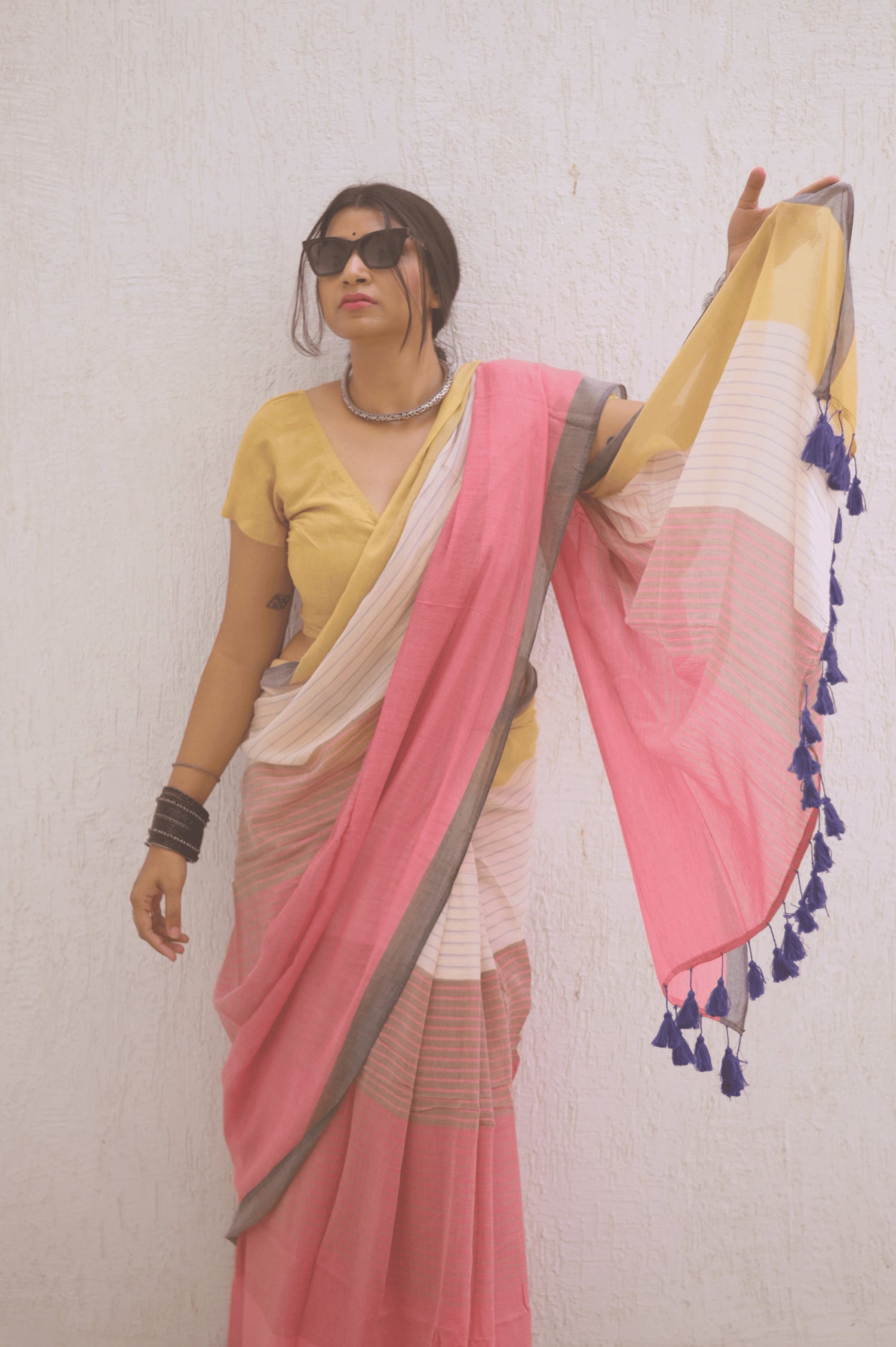
A manthrakodi is a once-in-a-lifetime saree. These MAYIN sarees are not manthrakodis: they are lighter choices in the same cream, gold and red family, for the engagement, the eve of the wedding, a guest's outfit or the first visits after the wedding. Every MAYIN saree is 5.5 m long and 45 inches wide, and delivery in India is free on orders of ₹2,000 and above. You can also browse our Kerala sarees and wedding sarees.
 Miss Earth Tissue SareeMiss earth tissuePair with Gold, maroon, red
 Bright SideWhite mulmul cotton with yellow borderPair with Gold, yellow, green
 On RepeatYellow handloom linen with zari borderPair with Gold, maroon, green
 Main EventBurgundy red pure handloom linen with zari borderPair with Gold, cream, bottle green
 ComposurePink pure handloom linen with zari borderPair with Gold, maroon, green
Miss Earth Tissue Saree is a handloom tissue with a zari border at ₹3,499, the closest in look to a gold tissue Kerala saree; it has no blouse piece and is dry clean only. Bright Side is a white mul cotton with a yellow border at ₹1,999, a light everyday nod to the cream and gold look; it has no blouse piece and takes a gentle cold hand wash. Main Event, On Repeat and Composure are pure handloom linens with zari borders at ₹4,499 each, with a 1 m blouse piece, dry clean only.
If you are a guest rather than the family, our guide to sarees for a South Indian wedding covers what to wear to a Kerala wedding, and our Onam saree guide has ideas for wearing kasavu again at festival time.
Questions People Ask
What is a manthrakodi saree?
It is the new wedding saree that the groom places over the bride's head during a Kerala wedding, as a promise to protect and care for her. In the church rite the priest blesses it first.
What does manthrakodi mean in Malayalam?
"Manthra" means blessed and "kodi" means new cloth, so manthrakodi means a blessed new cloth.
Is manthrakodi a Hindu or Christian custom?
Both use the word. The blessed manthrakodi, prayed over by the priest and placed over the bride's head, is part of the Kerala Christian wedding, in Syro-Malabar, Knanaya and Orthodox churches. At Kerala Hindu weddings the groom gives the bride a new saree, rooted in the older custom of giving a pudava, and that saree is often called the manthrakodi too.
Who buys the manthrakodi?
The groom's family buys it, and it is presented by the groom. Many families now shop for it together with the bride so she gets a colour and weight she likes.
When does the bride wear the manthrakodi?
It is placed over her during the wedding rite, and she usually changes into it after the service. She wears it for the rest of the day and the reception, and often again on later family occasions.
What colour is a manthrakodi?
Cream with a gold kasavu border, red or maroon with gold zari, and pale gold tissue are the most common. Many brides now choose a rich silk colour that suits them.
Are the thaali threads taken from the manthrakodi?
In many Kerala Christian weddings, yes: the cord for the thaali is traditionally made from seven threads drawn from the manthrakodi. Ask your parish what they follow.
What is the manthrakodi saree price?
As of 2026, roughly ₹2,000 to ₹5,000 for cotton kasavu, ₹4,000 to ₹15,000 for tissue, and ₹10,000 to ₹40,000 for pure silk with zari. Real zari pieces often cost more.
Is the manthrakodi the same as the wedding saree?
Not always. A Christian bride usually wears a white or ivory saree into church and changes into the manthrakodi afterwards, so she wears two sarees that day.
Can the manthrakodi be silk?
Yes. Pure silk with zari is a common choice, especially for a reception. Cotton kasavu, tissue and silk cotton are lighter alternatives for a hot day.
How do I store my manthrakodi?
Dry clean it soon after the wedding, wrap it in cotton or muslin with the zari folded inside, and store it flat away from plastic and damp. Refold it every few months.
Can I wear my mother's manthrakodi at my wedding?
The manthrakodi is traditionally new cloth from the groom, so it is not usually reused in the rite. Many brides wear a mother's manthrakodi for another function, such as the engagement or the reception.


