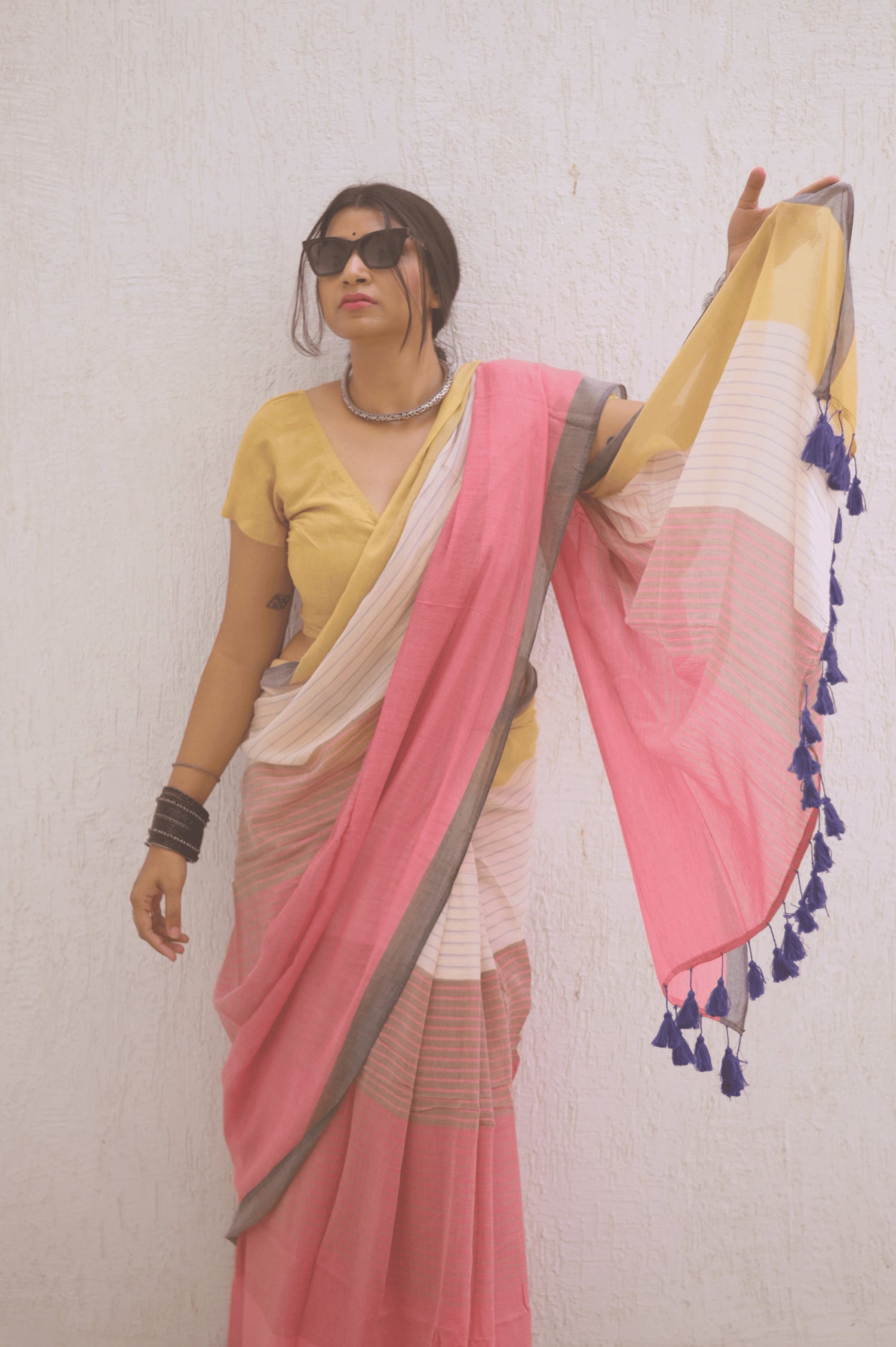


Saree for a South Indian Wedding: What Guests and Family Wear

For a South Indian wedding, most guests wear a silk saree, or a lighter silk cotton or zari bordered cotton in a bright, auspicious colour, with gold jewellery and flowers in the hair. Avoid all black, ask before wearing all white, and keep anything close to the bride's colour for another day. The rest depends on the family: a Tamil wedding at dawn, a Telugu muhurtham late at night and a temple wedding in Kerala that lasts only a few minutes each ask for slightly different things. This guide is for guests and family members. If you are the bride, see our South Indian bridal saree guide instead.
The Short Answer by Region
"South Indian" covers four states, several languages and many communities, and weddings differ more than the shared silk and jasmine suggest. Use the table as a starting point, then follow the invitation and the family.
Christian and Muslim weddings in the south follow their own customs, and guests often wear silk or lighter sarees in softer colours for a church service. If you are not sure what fits, a quick message to the family is never out of place. For full outfit ideas beyond this guide, see our wedding guest saree looks.
Muhurtham Timing and What It Means for Your Saree
Hindu weddings in the south are timed to a muhurtham, an auspicious window chosen from the calendar. At many Tamil and Kannada weddings it falls in the morning, and some ceremonies begin before sunrise. At Malayali weddings the tying of the thali often takes only a few minutes in the morning. Telugu weddings are the main exception: the muhurtham is often set in the evening or close to midnight. The time printed on the invitation is the one that matters, and it can be very early, so plan your saree around it.
For a late night Telugu muhurtham the problem is the opposite: you may be in the same saree from early evening until after midnight. Choose a blouse that is comfortable, not tight, and a drape that will hold through hours of standing, sitting and the shower of rice and petals during the ceremony.
Silk, Silk Cotton or Cotton
Silk is the traditional choice for the main ceremony, and many families still expect it of close relatives. Guests have more freedom. A lighter silk, a silk cotton or a good cotton with a zari border is widely worn, especially at daytime weddings in the hot months. What matters most is that the saree looks festive: a bright colour, a woven or zari border and a crisp drape.
Kanjivaram silk is the best known wedding silk of the south, with its contrast borders and pallus. Our Kanjivaram saree guide explains how to read the weave and the price. Lighter weaves are worth knowing too. In Telangana, Gadwal and Narayanpet sarees are woven in cotton, silk or a mix of the two, often with zari borders. For how the blends compare, see our cotton silk saree guide.
Colours Families Choose, and Colours Some Avoid
Bright, warm colours are the safe choice at almost every South Indian wedding. Yellow and turmeric shades, mango, parrot and bottle green, peacock blue, magenta, rani pink and deep purple are all widely worn, often with a contrast border. Customs on colour vary by community and by family, so treat the list below as common practice, not rules.
Black. Many families think black inauspicious at a wedding ceremony, and most guests leave it for the reception, if at all. White. All white is linked with mourning in many Tamil and Telugu homes, so it is often avoided. White with a bright border is a different matter: a Telugu bride often wears a white saree with a red border for one ritual, and in Kerala, cream and gold kasavu is the normal wedding wear for guests and the bride. See our kasavu saree guide for that look. Red. Red is welcome in many families, but avoid the bride's exact shade if you know it.
Temple Venues and Dress Codes
Many South Indian weddings take place in a temple or in a hall attached to one. Temples often have dress codes, and they are stricter than a wedding hall. At Guruvayur in Kerala, for example, women may wear a saree, a skirt with a blouse, or a churidar. Expect to leave your footwear outside, to stand or sit on stone floors, and to have little space: temple wedding stages can be very small, with room for the couple, their parents and a few others.
For more on dressing for temples in general, see our guide to a saree for a temple visit.
Sitting on the Floor and a Hot Day
Guests at South Indian weddings often sit on the floor for part of the ceremony and eat lunch on a banana leaf, traditionally with the right hand. Add a hot day in a crowded hall and comfort matters as much as looks.

For more on light fabrics and colours for the hot months, see our summer wedding saree guide.
Flowers in Your Hair
Jasmine is part of the wedding look across the south. Women usually wear strands of jasmine in the hair, either wound round a bun or pinned down a plait. In Tamil Nadu, Madurai jasmine, known as Madurai Malli, was registered as a Geographical Indication in 2013. Orange kanakambaram and rose are often added for colour, and guests sometimes shower petals on the couple during the ceremony.

Jewellery and Finishing Touches
Gold or gold-tone jewellery is the norm. Temple jewellery, with motifs of deities, lotuses and peacocks, is widely worn. A guest usually wears one necklace, jhumkas or studs, bangles and a small bindi; close family often wear more. Match the metal to the zari: gold zari with gold, silver zari with silver or oxidised pieces. Keep it to what you can manage through a long day of sitting, standing and eating with your hands.
For pairing jewellery with necklines and sarees, see our guide to jewellery for a saree.
Close Family and Elders
Family members are usually dressed more formally than guests. Mothers, aunts and grandmothers often wear their best silks, and in Tamil Brahmin families the bride and some married women of the family wear the nine-yard drape known as madisar. Sisters and cousins tend to coordinate, choosing colours that sit well beside the bride without matching her. If you are the mother of the bride or groom, see our saree for the mother of the bride and groom guide for colour, weight and blouse choices.
At many Malayali Hindu weddings, the groom places a new saree, the manthrakodi, over the bride's head during the ceremony. Our guide to the manthrakodi saree explains that custom.
What to Wear to the Reception
The reception is usually in the evening, in a hall or hotel, and the rules relax. Guests often change out of their silk into something lighter and more evening-like: a sequin or embroidered chiffon, a printed chiffon, or a light silk in a deep colour. Black, wine and navy, often avoided at the ceremony, are much more common here.
For a full set of reception ideas, see our saree for a wedding reception guide.
Sarees in This Guide
For a daytime ceremony, a handloom linen with a zari border or a tissue saree gives a festive sheen with far less weight than silk. Every MAYIN saree is 5.5 m long and 45 inches wide. On Repeat, Composure and Main Event are pure handloom linen with a zari border, ₹4,499 each, with a 1 m blouse piece, and are dry clean. The Miss Earth Tissue Saree (₹3,499) and Siyaahi, a striped mul cotton with zari (₹2,199), come without a blouse piece and are dry clean. Main Event is a burgundy red, so check it is not close to the bride's colour.
For the reception, Midas and Sapphire are pure chiffon sequin sarees (₹7,999), and Orelia is a green floral print pure chiffon (₹3,999). Each comes with a 1 m crepe blouse piece and is dry clean. You can see more in our linen sarees. Delivery is free in India on orders of ₹2,000 and above.
 On RepeatYellow handloom linen with zari borderPair with Green, gold
 ComposurePink pure handloom linen with zari borderPair with Green, gold
 Main EventBurgundy red pure handloom linen with zari borderPair with Gold, mustard
 Miss Earth Tissue SareeMiss earth tissuePair with Maroon, gold
 SiyaahiMulticolour striped mul cotton zariPair with Black, gold
 MidasResin gold sequin pure chiffonPair with Maroon, black
 SapphireRoyal blue gold sequin pure chiffonPair with Gold, royal blue
 OreliaGreen floral print pure chiffonPair with Green, gold
Questions People Ask
What should I wear to a South Indian wedding as a guest?
A silk saree is the classic choice, but a silk cotton, a zari bordered cotton or a handloom linen in a bright colour is widely worn by guests, especially in hot weather. Add gold jewellery and jasmine in your hair.
Do I have to wear a silk saree to a South Indian wedding?
No. Silk is expected more of close family than of guests. A festive lighter weave with a woven or zari border is perfectly acceptable for a guest.
Can I wear black to a South Indian wedding?
Many families think black inauspicious at the ceremony, so most guests avoid it. Black is more common at the evening reception.
Can I wear white to a South Indian wedding?
All white is often avoided at Tamil and Telugu weddings because it is linked with mourning. Cream and gold kasavu is normal at Kerala weddings, and white with a bright border is often fine; ask the family if unsure.
Can I wear red to a South Indian wedding?
Usually yes, but avoid the bride's exact shade if you know it. A red with a contrast border is a safer choice than plain bridal red.
What time do South Indian weddings start?
Many Tamil, Kannada and Malayali muhurthams are in the morning, some before sunrise. Telugu muhurthams are often in the evening or late at night. Always go by the time on the invitation.
Can I wear a cotton saree to a South Indian wedding?
Yes, as a guest, if it looks festive: a good handloom cotton or silk cotton in a bright colour with a zari border. Keep plain everyday cottons for other days.
What jewellery should I wear to a South Indian wedding?
Gold or gold-tone pieces: a necklace, jhumkas, bangles and a bindi. Temple jewellery is popular, and close family usually wear more than guests.
Should I wear flowers in my hair to a South Indian wedding?
It is common and welcome. A strand of jasmine round a low bun or down a plait is the usual way.
What do you wear to a Kerala wedding?
Many guests wear cream and gold kasavu or a light silk or cotton with a gold border. Ceremonies are often short and in the morning, followed by a sadya.
What should I wear to a South Indian wedding reception?
Something lighter and more evening-like: sequin or embroidered chiffon, printed chiffon or a light silk. Darker colours are more common than at the ceremony.


