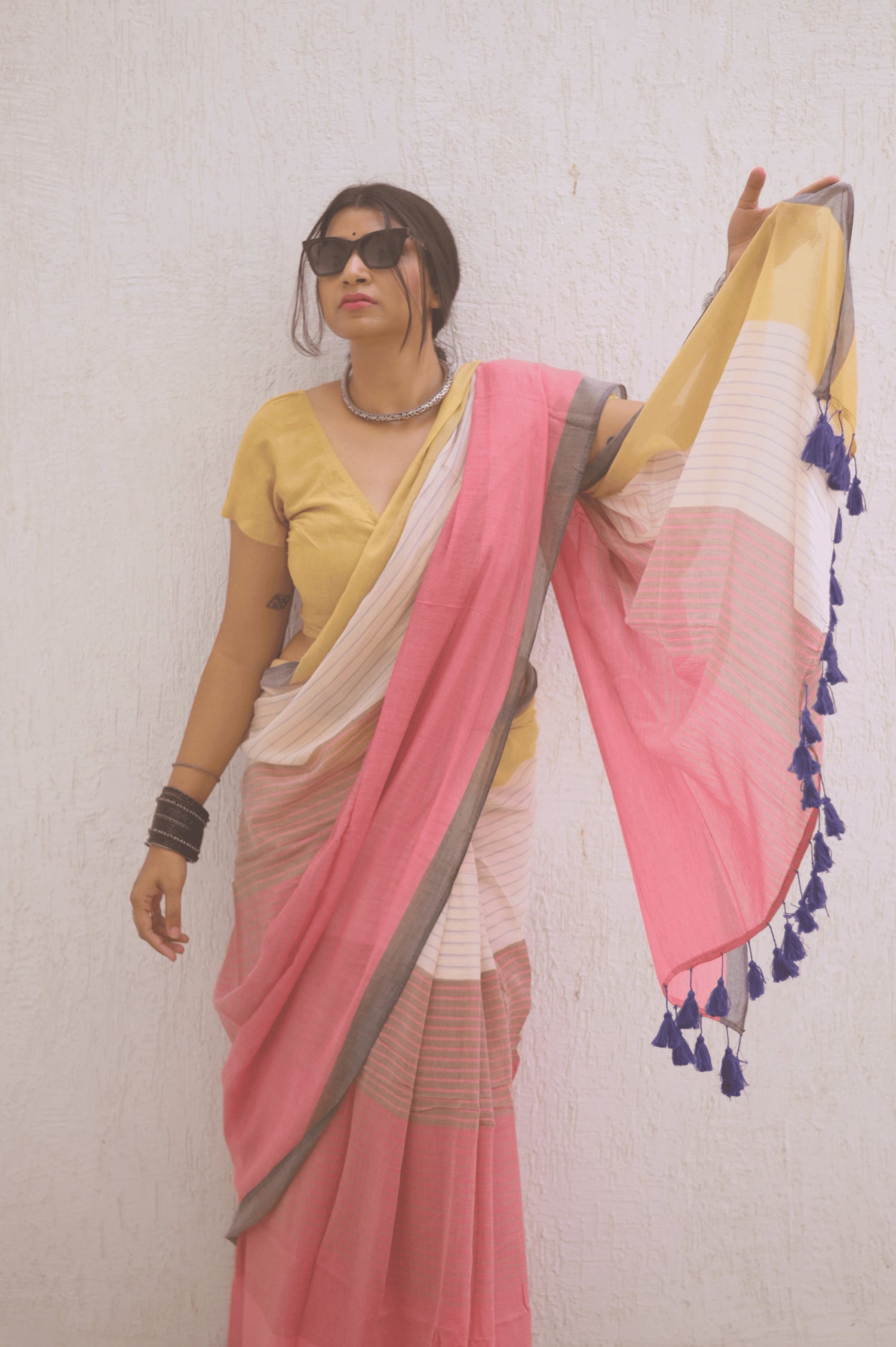


Christian Wedding Saree: Bridal White, Veil, Reception and Guest Looks

A Christian bride in India usually wears a white, ivory or cream saree to church, often with a gold border, paired with a sheer white veil and a blouse with sleeves. Many brides then change into a second, more colourful saree for the reception, and in some communities that second saree is a gift from the groom with its own meaning.
That is the broad picture. The details change from one community to the next, and even from one parish to the next. Below we walk through the bridal saree and veil, what Kerala, Goan, Mangalorean and Tamil Christian families often do, the blouse, fabrics and the reception change, then what mothers, sisters and guests wear. Customs vary by church and by family, so when in doubt, ask the couple or the parish office. For bridal sarees across all faiths, see our bridal saree guide.
The White or Ivory Bridal Saree
White at a Christian wedding comes from the western church wedding, where the white dress came to stand for purity and a new beginning. In India it met a saree culture that already prized off-white with gold, especially in Kerala, so the white bridal saree feels at home in both worlds.
Very few bridal sarees are a stark optical white. Most are a soft white, ivory, cream or a warm off-white, and the shade you choose changes how the saree looks in photographs and under church lights.
Hold the saree against your face in daylight, not under shop tube lights. If you are buying the veil separately, take a cutting of the saree with you: a pure white veil over an ivory saree can make the saree look dull, so match the veil to the saree or go a shade lighter. Our white saree styling guide covers makeup and jewellery for white in more depth.
Four Traditions: Kerala, Goan, Mangalorean, Tamil
Indian Christians belong to many churches, including Catholic, Syro-Malabar, Orthodox, Mar Thoma, Church of South India and Pentecostal congregations, and each region has blended its own customs into the service. Here is what is often seen. Treat it as a starting point, not a rule.
The Kerala manthrakodi and minnu
In Kerala Christian weddings the groom places the manthrakodi, a wedding saree, over the bride during the rites. Strands drawn from it are twisted into the cord for the minnu, a small gold pendant with a cross, which the groom ties around the bride's neck after the priest blesses it. The bride changes into the manthrakodi after the service and many women keep it for life. For the Kerala off-white and gold weave, see our kasavu saree guide.
Goan and Mangalorean Catholic weddings
Goan and Mangalorean Catholic weddings share Konkani roots. Before the wedding comes the ros (also spelt roce), where family anoint the bride and groom with coconut milk, so wear something washable. The bride's red sado is the saree with the deepest meaning in Mangalorean homes: it is given by the groom, and many brides change into it mid-way through the reception. A second saree, sometimes called the dharma sado, is given by her own family.
Tamil Christian weddings
Many Tamil Christian families keep the thali, tied by the groom in church, alongside the ring. Brides often wear a white or ivory silk saree with a veil for the service, and a coloured silk for the reception. For the wider southern bridal picture, read our south Indian bridal saree guide.
Wearing a Veil with a Saree
A veil over a saree has to sit on the hair, not on the pallu, or it slides with every step. Fix your hair first, drape the saree, then add the veil last.
Some brides wear the saree pallu itself over the head instead of a separate veil, as many older family photographs show. If you do this, pin the pallu to the hair at the crown with two bobby pins and keep the pallu edge straight across the forehead. Our step-by-step saree draping guide covers the nivi drape from the first tuck.
The Bridal Blouse for a Church Service
Most churches ask for covered shoulders and a modest neckline during the service. That does not mean plain: it means the detail moves to the sleeves, the back and the fabric.
A second blouse for the reception saree lets you go sleeveless or open-backed later in the evening. For ideas and measurements, see bridal blouse designs and the best blouse for a white saree.
Fabrics for the Church Saree
The church saree is usually worn for several hours, often through a long service, photographs and lunch, so weight and breathability matter as much as shine.
The Reception Saree
The reception is where colour comes back. In Kerala the bride often appears in the manthrakodi, and in Mangalorean homes she may change into the red sado. Elsewhere it is simply a chance to wear something brighter and easier to dance in, often a jewel-toned silk, a sequin chiffon or a pastel with shine.
If you change mid-evening, keep the second drape simple: pre-pleat and pin it the day before, and have the second blouse, petticoat and pins packed in one labelled bag. Our reception saree guide goes through colours and fabrics in detail, and the reception sarees collection has options for the family too.
What Family and Guests Wear
Guests at an Indian Christian wedding dress much as they would for any formal church service, with a little more festivity. Sarees are welcome from every guest, whatever their own faith.
For more guest looks by season and time of day, see wedding guest saree looks.
Colours to Favour and Colours to Skip
There are no strict rules, but a few habits are widely shared. The main one: white belongs to the bride, so guests usually avoid a saree that is all white.
Ivory or cream with a coloured border or print is usually fine for a guest, because it does not read as bridal. Black is often worn at evening receptions in cities, but many families still feel it is out of place in church. When unsure, pick a soft colour for the service and save the bold one for the evening. For pairing ideas, see our saree colour combinations.
Planning the Day, Step by Step
Sarees in This Guide
These MAYIN sarees are not bridal church sarees. They suit guests, sisters, mothers and the reception, and the white one suits pre-wedding gatherings and the day after. Every MAYIN saree is 5.5 m long and 45 inches wide.
 Gardenalia WhiteFloral embroidered mulmul cottonPair with White, gold, mint
 FrangipaniBeige floral hand painted chiffonPair with Beige, gold, blush pink
 Lilac BloomLavender floral original dhakai jamdaniPair with Lavender, silver, ivory
 Miss Earth Tissue SareeMiss earth tissuePair with Gold, cream, maroon
 SocialiteOld rose sequin chiffonPair with Pink, gold, ivory
 LovelaceBlush pink rose gold sequin pure chiffonPair with Blush pink, gold, ivory
 MidasResin gold sequin pure chiffonPair with Gold, ivory, maroon
Gardenalia White is a white mul cotton with floral embroidery, without a blouse piece, and is dry clean, at ₹2,199: a calm choice for a family prayer evening. Frangipani is a beige hand painted chiffon with a 1 m crepe blouse piece, dry clean, at ₹3,499, soft enough for church. Lilac Bloom is a lavender Original Dhakai jamdani, without a blouse piece, dry clean, at ₹4,999. Miss Earth Tissue Saree is a yellow handloom tissue with a zari border, without a blouse piece, dry clean, at ₹3,499, a good fit for a mother or aunt.
For the reception, Socialite is an old rose sequin chiffon at ₹3,499, and Lovelace and Midas are sequin pure chiffon sarees at ₹7,999. Each comes with a 1 m crepe blouse piece and is dry clean. Browse more in white sarees and sequin sarees. Free delivery in India on orders of ₹2,000 and above.
Questions People Ask
What does a Christian bride wear in India?
Usually a white, ivory or cream saree with a sheer white veil for the church service, though many brides, especially in Goa, wear a white gown. Many then change into a coloured saree for the reception.
What is a manthrakodi saree?
It is the wedding saree the groom places over the bride during a Kerala Christian wedding. Strands from it make the cord for the minnu, and the bride wears it after the service and at the reception.
What is the minnu?
A small gold pendant with a cross, tied around the bride's neck by the groom after the priest blesses it. Many women later move it to a gold chain and wear it for life.
Can I wear white to a Christian wedding as a guest?
It is best to avoid an all-white saree, since white is the bride's colour. Ivory or cream with a clear coloured border or print is usually fine.
Can I wear black to a Christian wedding?
Black is often fine at an evening reception, but many families feel it is out of place in church. A deep jewel tone is a safer choice for the service.
Do I need to cover my shoulders in church?
Most churches expect covered shoulders during the service. A blouse with sleeves is simplest, or carry a light stole.
How do I wear a veil with a saree?
Set your hair in a bun, drape the saree with the pallu pinned firmly at the left shoulder, then slide the veil comb into the bun and secure it with bobby pins. The veil should sit on the hair, not on the pallu.
What colour saree for a Christian wedding reception?
Brides often choose red and gold, rose gold, champagne or a jewel tone. Guests can go brighter and shinier than they did for church.
What is the sado in a Mangalorean Catholic wedding?
The sado is a red saree with gold given by the groom. Many brides change into it mid-way through the reception, and it holds deep meaning for the family.
Do Tamil Christian brides tie a thali?
Many Tamil Christian families keep the thali, tied by the groom, as a sign of marriage alongside the ring. Practice varies by church and family.
What should the mother of the bride wear at a Christian wedding?
Often a rich silk or tissue saree in gold, cream with colour, or a deep jewel tone, with a blouse that has sleeves for church.


