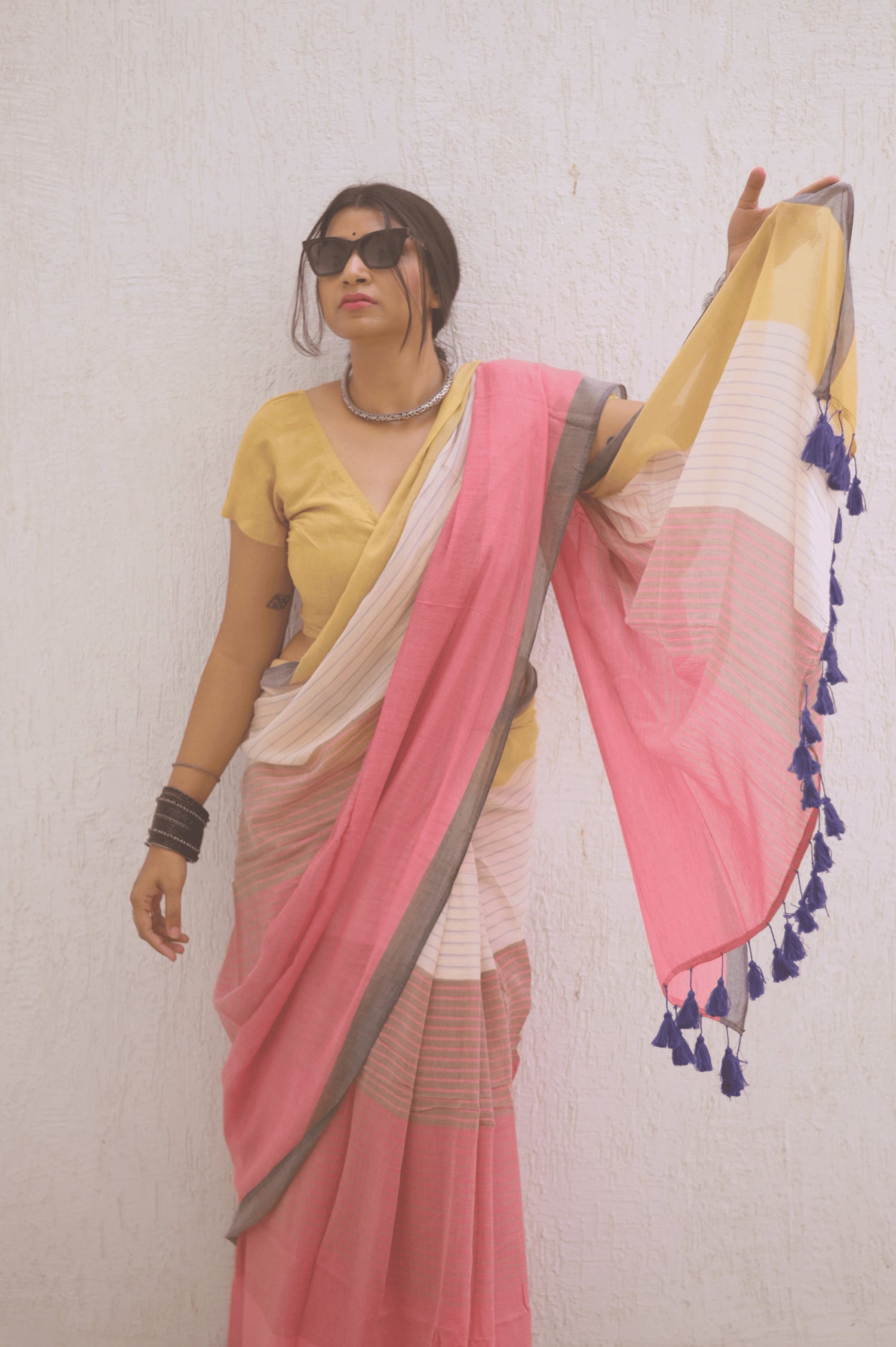


Kathpadar Saree: The Maharashtrian Border and Pallu Saree Explained

A kathpadar saree (काठपदराची साडी, kathpadarachi sadi) is a Maharashtrian saree whose border and pallu stand out from a comparatively plain body, usually in a contrast colour and often with zari. The name says exactly that: kath is the border or edge, and padar is the pallu. It is a way of building a saree rather than a separate weave, so you will find the kathpadar look on Paithani, Narayanpet, Karvat Kati and other handlooms worn in Maharashtra. This guide explains how to recognise one, which colours you usually see, how it differs from a Paithani or a Puneri, and how to wear and care for it.
What Kathpadar Means
In Marathi, kath (काठ) means a rim, edge or border; the Maharashtra government's Marathi dictionary gives it as one of the words for edge. Padar (पदर) is the pallu, the decorated end of the saree that goes over the shoulder. Paithani weavers use both words for the parts of their sarees, and textile writers describe the border and pallu of a Paithani together as its kath-padar.
So when a family in Pune or Kolhapur asks for a kathpadarachi sadi, they mean a saree with a proper border and pallu, usually in a contrast colour, over a body that is plain, checked or lightly dotted with small motifs.
How to Recognise a Kathpadar Saree
Because kathpadar describes a layout, you recognise it by looking at three parts of the saree and how they relate. Spread the saree flat, or open the first fold of the pallu in the shop, and check these points.
Where Kathpadar Sarees Are Woven
There is no kathpadar town. The look comes from several weaving traditions that Maharashtrian women have long worn. Each is covered in its own guide, so here is only what makes each one a kathpadar saree.
The Puneri cotton is a near relative. It has a thin zari-lined border and a tok padar, a pallu of vertical stripes, so it is a quieter take on the same idea. The Puneri saree guide covers its border names and how to tell a handloom piece.
Kathpadar vs Paithani vs Puneri
The question people ask most is whether a kathpadar is a Paithani. It can be. A Paithani with a plain body, a contrast zari border and a matching zari pallu is a kathpadar Paithani. But a Narayanpet or Karvat Kati with a contrast border is a kathpadar too, and a Paithani covered in an all-over jaal or dense buttas is not really described that way, because the body is no longer quiet.

Colour Pairings You Usually See
A kathpadar works because of the contrast, so the colour pair matters more than in most sarees. There is no fixed official list, but the same pairings come up again and again in Paithani colour traditions and in Narayanpet weaving, which documents combinations such as black with mustard, emerald with yellow, maroon with leaf green, pink with purple and maroon with mustard.
The names in brackets are traditional Paithani colour names, and older relatives and weavers still use them. A border in a deep jewel colour against a lighter body looks festive. A border close in tone to the body, such as maroon on deep red, looks quieter and suits pujas and daytime visits.
Cotton or Silk, and What It Costs
Since kathpadar is a layout, the fabric depends on which weave you buy. That changes the weight, the feel, the care and the price far more than the border does.
Prices vary a great deal by weave and by how much zari is used. As of 2026, roughly, handloom cotton kathpadar sarees sit in the low thousands, while a handwoven pure silk Paithani with a kathpadar layout usually costs five figures and rises steeply with zari. A saree sold as handwoven pure silk Paithani for well under ₹10,000 deserves careful questions. For silk and handloom, ask for the Silk Mark and Handloom Mark labels, and the GI tag where the weave has one. The guide to the Silk Mark and Handloom Mark explains what each label proves.
Gudi Padwa, Mangalagaur and Other Occasions
The kathpadar is the saree many Maharashtrian families reach for on festival mornings. It looks traditional without being bridal, and it photographs well in a group because the border frames each person.
Drape, Blouse and Jewellery
A kathpadar saree can be worn in the nivi style or draped as a nauvari. The nivi needs no special length: pleats at the front, the pallu over the left shoulder, and the border showing along the hem and down the pallu. A true nauvari drape needs a nine yard saree, about 8 to 8.5 metres, which is much longer than a standard 5.5 metre saree. The nauvari saree guide covers lengths and the drape itself.
For the blouse, the simplest rule is to match the border, not the body. A green saree with a pink border looks most complete with a pink blouse. A blouse in the body colour works too, but loses some of the contrast that gives the saree its name. A nath (nose ring) and traditional gold jewellery complete the Marathi festive look.
Caring for a Kathpadar Saree
Care follows the fabric and the zari. The border is where trouble starts: deep border dyes can bleed into a lighter body, and zari tarnishes or snags if handled roughly.
Sarees in This Guide
These are a lighter alternative, not kathpadar handlooms: MAYIN border sarees in a similar spirit, with a contrast or zari border over a plain body, for days when a heavy silk is too much. Each is 5.5 metres long and 45 inches wide. The linen sarees cost ₹4,499, come with a 1 m blouse piece and need dry cleaning. Bright Side is mul cotton, comes without a blouse piece and takes a gentle cold hand wash. You can browse more in border sarees.
 On RepeatYellow handloom linen with zari borderPair with Bottle green, maroon, purple
 ComposurePink pure handloom linen with zari borderPair with Bottle green, maroon, gold
 Main EventBurgundy red pure handloom linen with zari borderPair with Bottle green, gold, black
 Bright SideWhite mulmul cotton with yellow borderPair with Yellow, red, green
Questions People Ask
What is a kathpadar saree?
A saree with a contrast border (kath) and pallu (padar) over a comparatively plain body. It is a layout found on several Maharashtrian and neighbouring weaves, not a weave of its own.
What does kathpadarachi sadi mean?
It is Marathi for a saree with a border and pallu. Families use it for a traditional bordered saree, as opposed to a printed or borderless one.
Is kathpadar a Paithani?
Not always. A Paithani with a plain body and a contrast zari border and pallu is a kathpadar Paithani, but Narayanpet, Karvat Kati and Ilkal sarees can have a kathpadar layout too.
What is the difference between kathpadar and Paithani?
Paithani is a silk and zari weave from Paithan and Yeola with a registered GI. Kathpadar describes how a saree is laid out, with a contrast border and pallu, whatever the weave.
Does kathpadar have a GI tag?
No. Kathpadar is not a weave or a place, so it has no GI tag of its own. Some weaves that carry the look, such as Paithani, Narayanpet and Karvat Kati, are registered GIs.
Which colours are traditional for a kathpadar saree?
Common pairs include bottle green with pink or maroon, deep red with green, purple with green, black with red or mustard, and yellow with green or red, often with gold zari.
Can I wear a kathpadar saree for Mangalagaur?
Yes, it is a popular choice. Pick silk or silk cotton for the puja, and a softer, well pinned drape for the games that follow.
What should I wear for Gudi Padwa?
A cotton or silk kathpadar in yellow, green or deep pink with a contrast border is a good choice. Gudi Padwa falls on 7 April in 2027.
Can a kathpadar saree be draped as a nauvari?
Only if it is a nine yard saree, about 8 to 8.5 metres. A standard 5.5 to 6 metre saree is draped nivi style, or as a shorter nauvari-style look.
What blouse goes with a kathpadar saree?
A blouse in the border colour usually looks best because it carries the contrast. A body colour blouse is quieter.
How do I wash a cotton kathpadar saree?
Test the border dye first, then wash it separately in cold water with a mild detergent, do not wring, and dry it in the shade.
How do I know a kathpadar saree is handwoven?
Turn the border over: a woven border shows its pattern on the back. Slight irregularity is common in handwoven pieces, but the surest check is the Handloom Mark, and the GI tag for weaves that have one.


