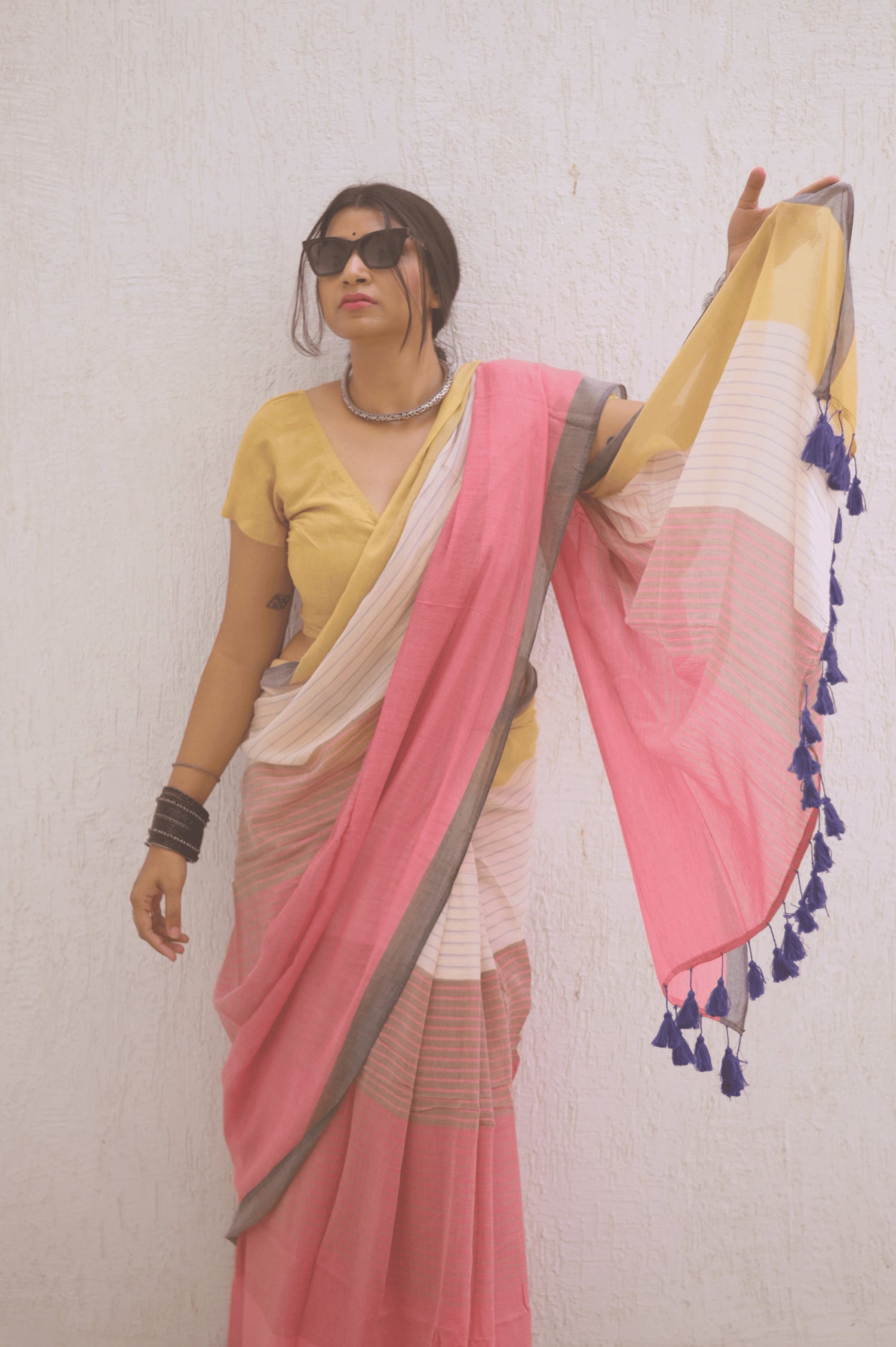


Karvati Tussar Saree: The Saw-Tooth Border Weave of Vidarbha

A Karvati tussar saree is a handwoven tussar silk saree from the Vidarbha region of Maharashtra, recognised by its saw-tooth border, the karvat, woven straight into the body of the cloth. The teeth are not printed or stitched on: they form on the loom where the coloured border weft and the natural tussar body weft lock into each other. The weave is woven mainly in Bhandara and Nagpur districts, and it was registered as a Geographical Indication in 2017 under the name Karvath Kati Sarees and Fabrics. You will also see it spelt karvathi, karvat kati or karwath kathi. This guide explains how it is made, how it differs from other tussar and from the Kanjivaram korvai join, how to check one before you buy, what it costs as of 2026, and how to wear and keep it.
What Is a Karvati Tussar Saree
In Marathi, karvat means a saw and kinar means a border, so a karvati kinar is a saw-edged border. The name describes the border, not the fibre. Traditionally that border sits on a body of tussar, the wild silk with a grainy, slightly uneven surface and a natural honey to deep beige colour. The border itself is usually woven in dyed mercerised cotton, in strong colours such as red, maroon, green or black, often with fine white or yellow lines running alongside.
So a classic Karvati is a two-fibre saree: a pale, undyed tussar body, a crisp cotton border in contrast, and a row of triangular teeth where the two meet. The teeth are often read as small temple spires, and weavers trace many of their border motifs to the sculpture at the Ramtek temple near Nagpur. If you want the wider story of tussar itself, how the wild silkworm is reared and how the yarn is reeled, our tussar silk saree guide covers it. Here we stay with what makes Vidarbha's weave its own.
Where It Is Woven
Vidarbha, the eastern part of Maharashtra around Nagpur, has forests where tussar cocoons grow wild, and that local supply shaped the craft. According to the GI filing, reeling is centred in Chandrapur and Gadchiroli, and weaving in Bhandara and Nagpur. Pauni, a town in Bhandara district on the Wainganga river, grew as a cotton handloom and trade centre in the 18th century and became known for silk and tussar in the 19th. Craft accounts also name Andhalgaon, Mohadi and Palandur in Bhandara district as weaving villages.
Before tussar took over, weavers in these villages wove the same saw-tooth border on cotton gamchhas. When local tussar became easy to get, they moved the border onto silk, and the Karvati tussar saree took shape. Much of the weaving is done by families of the Koshti weaving community, with skills passed down at home. Today the same looms also make dupattas, stoles, dress material and shirting.
How the Saw-Tooth Border Is Woven
The karvat is a weft trick, and it is the heart of this saree. Three shuttles work across the loom at once: one carries the tussar weft for the body, and one on each side carries the cotton weft for a border. Where a border weft meets the body weft, the two loop around each other and turn back, so each colour stays in its own zone. This interlocking is a kind of tapestry weaving.
The teeth appear because the weaver changes the meeting point row by row. As the GI filing puts it, the border and body wefts are interlaced across a decreasing group of warp threads, so the colour line steps inwards and then back out, making a triangle. Repeat that, and you get a row of saw teeth. It is slow, careful work, and the evenness of the teeth is the best sign of a practised hand.
Body, Border and Pallu
Read a Karvati from the centre out. The body is usually plain natural tussar, sometimes with checks, stripes or small butis on rarer pieces. The border carries tiny motifs arranged in two or three rows, separated by thin lines in a strong colour. Weavers have local names for many border designs, among them rui phool, karan phool, jai phool, dholak kinar and lahari, and you may see these on listings.
The pallu tells you most about the work and the price. Three pallu styles are named in official descriptions:
The temple-spire border is shared in spirit with other Indian weaves, which our temple border saree guide looks at across regions. What sets the Karvati apart is that its teeth come from interlocked wefts in two different fibres.
GI Status and What It Covers
Karvath Kati Sarees and Fabrics is a registered Geographical Indication. The application, number 390, was filed in January 2013 by the Maharashtra State Handlooms Corporation and the certificate was issued on 26 April 2017, covering sarees and fabrics in classes 24 and 25. The Handloom Export Promotion Council lists it among Maharashtra's GI handlooms, alongside Paithani and the Solapur chaddar and towel.
A GI protects the name for the region and the method. In practice it means a saree sold as Karvath Kati should come from the registered area and be made the registered way. It does not mean every genuine piece carries a GI tag or label, and a label on its own is not proof. For more on how GI and other marks work, see our GI tag sarees guide and the explainer on Silk Mark and Handloom Mark.
Karvati vs Other Tussar and vs Kanjivaram Korvai
Two comparisons come up most. Against other tussar sarees, the difference is the border: tussar from Bhagalpur or Jharkhand is usually sold for its cloth and prints, while a Karvati is defined by its woven saw-tooth edge. Against the Kanjivaram korvai, the method is related but the result is not. Korvai, meaning in sync, also uses three shuttles to lock a contrast border to the body weft by weft. But a korvai Kanjivaram is mulberry silk with zari, needs two weavers working together, and is a heavy wedding silk. A Karvati joins a light tussar body to a cotton border, with the saw teeth as its signature.
For the Kanjivaram side of this, our Kanjivaram saree guide explains korvai and petni joins in detail. If you like the slubbed texture of Karvati, ghicha silk is the spun tussar yarn some Karvati bodies use.
How to Spot a Handwoven Karvati
Printed and machine-made copies of the saw-tooth border are common, often in polyester or art silk with a tussar-look finish. Most can be caught with a few slow checks in good daylight.
Karvati Tussar Saree Price in 2026
Price follows the yarn, the pallu and how much skilled work went into the piece. Bands overlap, and a jala pallu is not always the dearest: some cooperative pieces with one sell in the middle band. As of 2026, roughly:
A Karvati far below these bands is worth a second look: check the fibre and the back of the border. Buying from a weaving cooperative or a state handloom outlet makes it easier to know what you are paying for. Listings vary in length, so confirm the measurement; one GI handloom piece we checked measured 6.5 m by 1.2 m. Ask too whether a blouse piece is included.
Occasions and How to Style It
In Vidarbha the Karvati is a bride's saree for ritual functions and a saree for auspicious days. It is also worn for Diwali, baby showers and, in simpler versions, everyday wear. Because tussar is light and breathes, it suits warm days far better than a heavy silk.
For a full Maharashtrian look built around a handwoven saree, see our Marathi bridal look guide, and our Paithani saree guide for the state's other GI silk.
Caring for a Karvati Tussar
A Karvati mixes a silk body with a dyed cotton border, so it needs a little more care than either alone. Dry cleaning is the safest choice, and many sellers advise it. Strong border colours can bleed into the pale tussar if the saree sits wet.
Our guides on how to store silk sarees cover storage through the monsoon in more detail.
Sarees in This Guide
A Karvati is a weave in its own right, and the place to buy one is close to its weavers. If you love its look, a pale handwoven body framed by a clear, contrasting border, these MAYIN sarees are a lighter alternative in the same spirit, not a Karvati. The pure handloom linen sarees have a textured handwoven body and a zari border, cost ₹4,499, measure 5.5 m by 45 inches, and come with a 1 m blouse piece; they are dry clean. Miss Earth is a handloom tissue saree at ₹3,499, without a blouse piece, also dry clean. Browse more in linen sarees and handloom sarees. Free delivery in India on orders of ₹2,000 and above.


Questions People Ask
What is a Karvati saree?
A handwoven saree from Vidarbha, Maharashtra, with a saw-tooth border woven into the body. Traditionally the body is natural tussar silk and the border is dyed cotton.
What does karvat kati mean?
Karvat means saw in Marathi, so karvat kati means saw-edged. It names the triangular teeth along the border.
Where is the Karvati saree from?
From the Vidarbha region of Maharashtra. Weaving is centred in Bhandara and Nagpur districts, with tussar reeled in Chandrapur and Gadchiroli.
Does the Karvati saree have a GI tag?
Yes. Karvath Kati Sarees and Fabrics was registered as a Geographical Indication, with the certificate issued on 26 April 2017.
Is the Karvati border cotton or silk?
In the classic saree the border is mercerised cotton, dyed in a strong colour, and the body is tussar silk.
How is the karvati border woven?
With three shuttles, one for the body and two for the borders. The body and border wefts interlock, and the weaver steps the meeting point to form the teeth.
Is Karvati the same as Kanjivaram korvai?
No. Both interlock a contrast border with three shuttles, but korvai joins a mulberry silk and zari border to a heavy silk body, while Karvati joins a cotton border to a light tussar body in saw teeth.
How can I tell if a Karvati saree is handwoven?
Check the back of the border: woven teeth show on both sides. Look for slight variation between teeth and the dry, slubbed feel of real tussar.
What is the price of a Karvati tussar saree?
As of 2026, roughly ₹5,000 for a simple piece, about ₹8,500 to ₹9,500 for many GI handloom pieces, and up to ₹25,000 or more for the most elaborate pallu work.
What is a jala pallu in a Karvati saree?
The most complex of the three pallu styles, with dense woven designs that need a highly skilled weaver. Tekri is the simplest and devdi sits between them.
Can I wear a Karvati saree in summer?
Yes. Tussar is light and breathable, so a Karvati is comfortable on warm days and for daytime functions.
How do I wash a Karvati tussar saree?
Dry clean it, especially the first time, because the dyed cotton border can bleed into the pale body. Iron on the reverse at a low setting.


