

Jamawar Saree: Kashmir Shawl Roots, the Banarasi Weave, Paisleys and Care

A jamawar saree is a saree woven with the dense, many coloured paisley and floral patterns of the old Kashmir jamawar shawls. Today most jamawar sarees are Banarasi silks, woven in and around Varanasi with coloured silk threads that build the design into the cloth, while a true Kashmiri jamawar is a rare, slow handwoven piece. This guide explains where the name comes from, how the Kashmir shawl became a Banaras saree, how the weave works, what the motifs mean, how to tell handwoven jamawar from machine copies and prints, and how to look after one.
What a Jamawar Saree Is
Jamawar is a design tradition first, and a weave second. The word describes cloth covered edge to edge with paisleys, flowering vines and floral sprays, arranged so densely that very little plain ground shows. When people in India say jamawar saree today, they usually mean one of three things: a handwoven Banarasi silk in the jamawar style, a power loom or jacquard copy of that look, or a print of jamawar patterns on a lighter fabric.
What sets a good jamawar apart from an ordinary brocade is colour. A typical Banarasi brocade relies on gold or silver zari. A jamawar relies mostly on silk threads in several colours, with zari as an accent if it is used at all. The result is softer, richer and heavier, closer in feel to a woven shawl than to a shimmering wedding silk.
The Name and the Kashmir Shawl Origin
Jamawar is usually explained as jama, a robe, and war, a yard. The patterned cloth was bought by the length by nobles and wealthy families, then cut and stitched into robes, or worn whole as a wrap. In the Persian world the same kind of cloth was worn as the choga (a long coat), the patka (a waist sash) and the dastar (a turban). In South Asia it became, above all, the shawl.
By the 1700s and 1800s Kashmir was the most important centre for jamawar. The finest pieces were woven from pashm, the soft underfleece of Changthangi goats from the high Himalayan plateau. Pashm simply means soft hair in Persian. A jamawar length of the early 1800s in the RISD Museum collection is about 2.7 m long, woven in kani, a twill tapestry weave where each colour is worked in by hand, area by area. A single length could take workshops months or even years.
Handweaving of this kind still continues in Kashmir, but among a small number of craftspeople. Most cloth sold as jamawar now is made elsewhere, by other methods, which is where Banaras comes in.
How the Buta Travelled and Became Paisley
The motif at the heart of jamawar is the buta, a curved teardrop with a bent tip. Shawl historians suggest it may come from the cypress tree of pre Islamic Iran. In the Mughal period, from the 1500s on, it was blended with flowering plants, so early butas often look like a small bouquet with a curling top. Over two centuries it grew larger, more stylised and more crowded, until whole shawls were filled with it.
So the word paisley is a Scottish name for an Indian and Persian motif, made famous by imitations. In India you will hear it called buta, buti (small), kairi or ambi (mango), and Banaras weavers use kalgha (often spoken as kalka) for a large buta of this shape. Jacquard looms, which read the pattern from punched cards, are also the ancestors of the machines that weave most jamawar copies today.
Banarasi Jamawar: How the Weave Works
Banaras took up jamawar through a related silk weave called tanchoi. Government textile documentation records that tanchoi is believed to have been introduced in Surat in the late 1800s by three Parsi brothers who had learned it in China, and was woven in Bombay until the 1950s, when cheaper Varanasi versions took over. Banaras weavers made the weave their own and used it to carry jamawar designs from Kashmir. For the link between tanchoi and Parsi dress, see our Parsi gara saree guide.
A Banarasi jamawar, often sold as jamawar tanchoi, has three parts to its construction:
That last point matters when you shop. In many Banarasi brocades the unused extra threads float loosely across the back and are sometimes cut away. In a well woven jamawar the back often looks like a dense version of the design, sometimes with the colours reversed, with no long hanging threads. Zari, if present, is usually limited to the border or a few accents.
Banarasi weaving is protected by a Geographical Indication. The GI for Banaras Brocades and Sarees was registered in 2009 for Uttar Pradesh. Our Banarasi saree guide covers the wider family of Banaras weaves, including jangla, tissue, cutwork and butidar.
Jamawar, Tanchoi, Brocade and Kani
These four words are used loosely by sellers, and they overlap. This is how textile writing and the trade usually separate them.
In practice, many sarees combine them. A jamawar tanchoi with a zari border is common, and some sellers call any busy paisley silk a jamawar. Ask what the weave is and what the threads are, rather than relying on the label.
Paisley and Other Jamawar Motifs
Government documentation of the Banaras jamawar tanchoi describes a clear layout: tiny paisleys packed across the body, large overlapping paisleys on the end panel, and miniature paisley creepers along the borders. Floral vines and bouquets fill the spaces between. Knowing this layout helps you read a saree quickly.
Colour is part of the motif language. Older and handwoven jamawars tend to use many colours that sit close together, such as rust, ochre, moss and deep blue on a dark ground, so the pattern reads as rich rather than loud. Bright, high contrast colours are more typical of newer power loom pieces.
Kinds of Jamawar Sarees and What They Cost
Price follows the method of making far more than the design. As of 2026, these are rough bands to expect in India.
All of these are legitimate to buy. The only problem is a machine or printed piece sold at a handloom price. A jamawar that is cheap, very light and bright on the face but plain and pale on the back is almost certainly printed, whatever the label says.
How to Identify a Handwoven Jamawar
Take the saree to good daylight, open the pallu and turn it over. Most of what you need to know is on the back.
Labels help, but each proves something different. Our Silk Mark and handloom mark guide explains what each tag covers, and GI tag sarees lists which weaves are protected. For a Kashmiri jamawar shawl or saree, the Kani GI label is the check to ask about; the Kashmiri saree guide explains it.
Wearing a Jamawar Saree
Jamawar is warm, heavy and busy, so it suits cooler months and evening events: winter weddings, receptions, Diwali and family functions. It is a natural choice for winter saree looks, and it photographs well under warm indoor light.
For sleeve and back ideas that suit heavy woven silks, see Banarasi blouse designs, and for open, pleated and wrapped pallus, saree pallu styles. A heavy jamawar holds pleats well, so five to seven pleats of about 4 to 5 inches each at the waist usually sit neatly.
Caring for a Jamawar Saree
A jamawar is mostly silk thread packed close together, so it is strong in wear but sensitive to water, heat, damp and insects. Treat it as you would any good silk, with a little extra care for the dense pallu.
Lighter Woven Sarees in This Guide
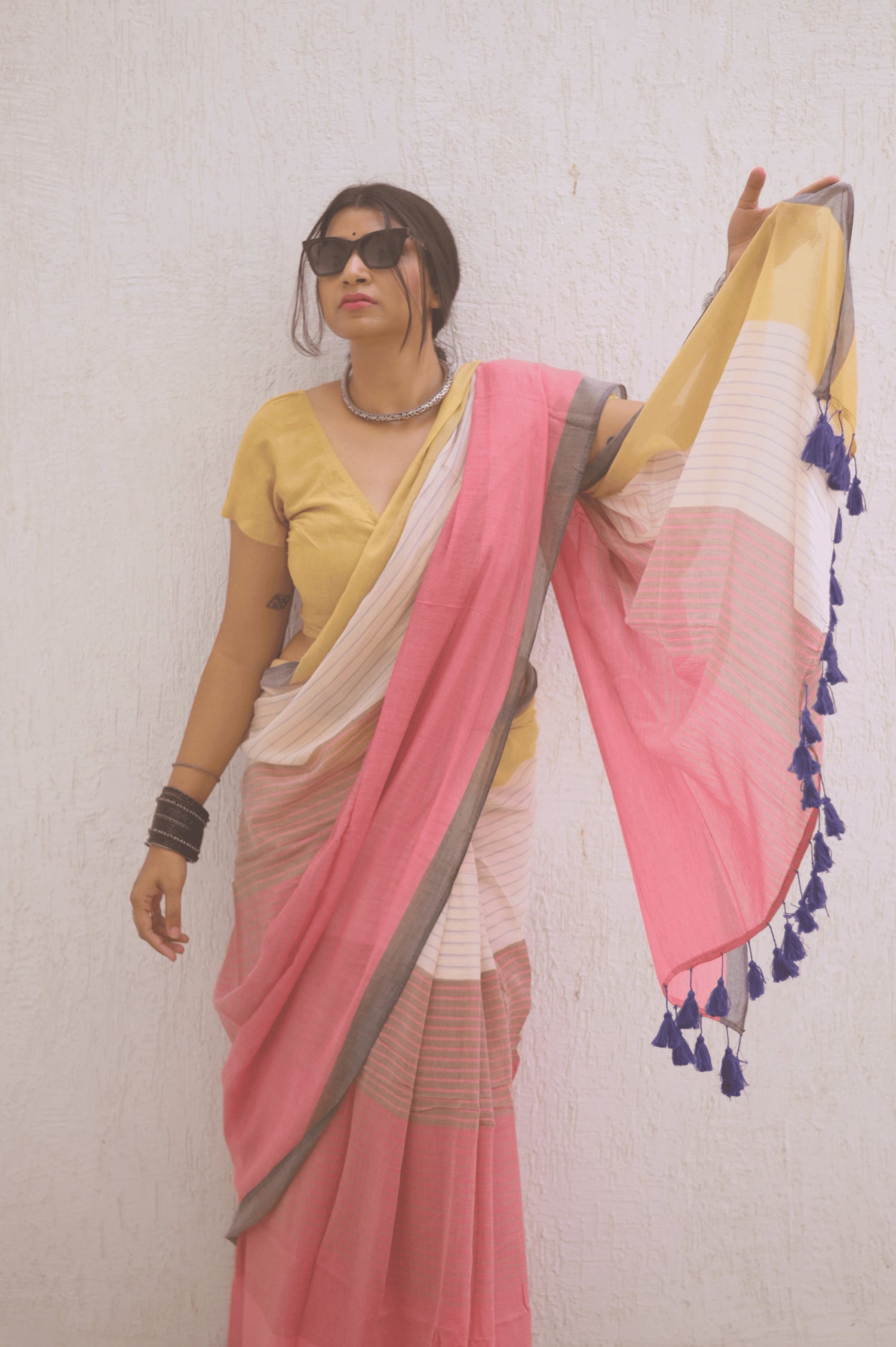
The MAYIN sarees below are lighter woven sarees for days when a heavy silk is too warm or too formal, with motifs or zari built into the cloth. Lilac Bloom is a lavender Dhakai jamdani, a weave where floral motifs are added thread by thread on the loom, at ₹4,999, without a blouse piece and dry clean only. Miss Earth is a handloom tissue saree at ₹3,499, without a blouse piece, dry clean only. On Repeat and Composure are pure handloom linen with zari borders at ₹4,499, each with a 1 m blouse piece, dry clean only. Manjari (₹2,299) and Emerald (₹2,099) are striped mul cotton with zari, without a blouse piece, dry clean only. Every MAYIN saree is 5.5 m long and 45 inches wide, with free delivery in India on orders of ₹2,000 and above. See more in jamdani sarees, zari sarees and handloom sarees.
 Lilac BloomLavender floral original dhakai jamdaniPair with Purple, silver
 Miss Earth Tissue SareeMiss earth tissuePair with Maroon, bottle green
 On RepeatYellow handloom linen with zari borderPair with Maroon, gold
 ComposurePink pure handloom linen with zari borderPair with Wine, gold
 ManjariRed striped mul cotton zariPair with Black, gold
 EmeraldGreen striped mul cotton zariPair with Mustard, ivory
Questions People Ask
What is a jamawar saree?
It is a saree woven with the dense paisley and floral designs of the old Kashmir jamawar shawls. Today most are Banarasi silks woven with coloured silk extra weft on a satin ground.
What does jamawar mean?
It is usually explained as jama, a robe, and war, a yard. The cloth was bought by the yard to be made into robes or worn as a wrap.
Is jamawar from Kashmir or Banaras?
The style comes from Kashmir, which was its main centre in the 1700s and 1800s. Most jamawar sarees are now woven in Banaras, where weavers adapted the tanchoi weave to carry jamawar designs.
What is the difference between jamawar and tanchoi?
Tanchoi is the weave: a satin ground silk patterned with silk extra weft and little zari. Jamawar is the design style, and in the trade a jamawar tanchoi often means a denser, many coloured paisley version.
Is jamawar the same as kani?
Not exactly. Kani is a Kashmir hand weave using many small bobbins, and historic Kashmiri jamawar was woven that way, but most jamawar sarees today are Banarasi silks or machine copies.
Is jamawar pure silk?
Handwoven Banarasi jamawar is usually pure silk, and Kashmiri pieces are usually pashm. Power loom and printed jamawar sarees are often blends or synthetics, so check the label and ask for a Silk Mark.
How can I tell if a jamawar saree is handloom?
Turn the pallu over in daylight. A handloom jamawar shows a dense reverse of the design and small differences between repeats, while machine pieces are perfectly uniform and prints look pale on the back.
Why is it called paisley?
The name comes from the town of Paisley in Scotland, which began weaving imitation Kashmir shawls from 1805. In India the motif is called buta, kairi or ambi.
How much does a jamawar saree cost?
As of 2026, roughly, a handloom Banarasi jamawar often costs ₹25,000 to ₹45,000, and more for complex pieces. Power loom versions usually cost a few thousand rupees, and prints less.
Can I wear a jamawar saree to a wedding?
Yes, it suits winter weddings, receptions and festive evenings. Keep the blouse plain in a colour from the motifs and let the pallu show.
How do I wash a jamawar saree?
Dry clean it. Washing at home can make coloured silk threads bleed and can distort the heavy pallu.
How should I store a jamawar saree?
Fold it in white muslin, keep it away from plastic, sun and damp, and refold it every few months along new lines.


