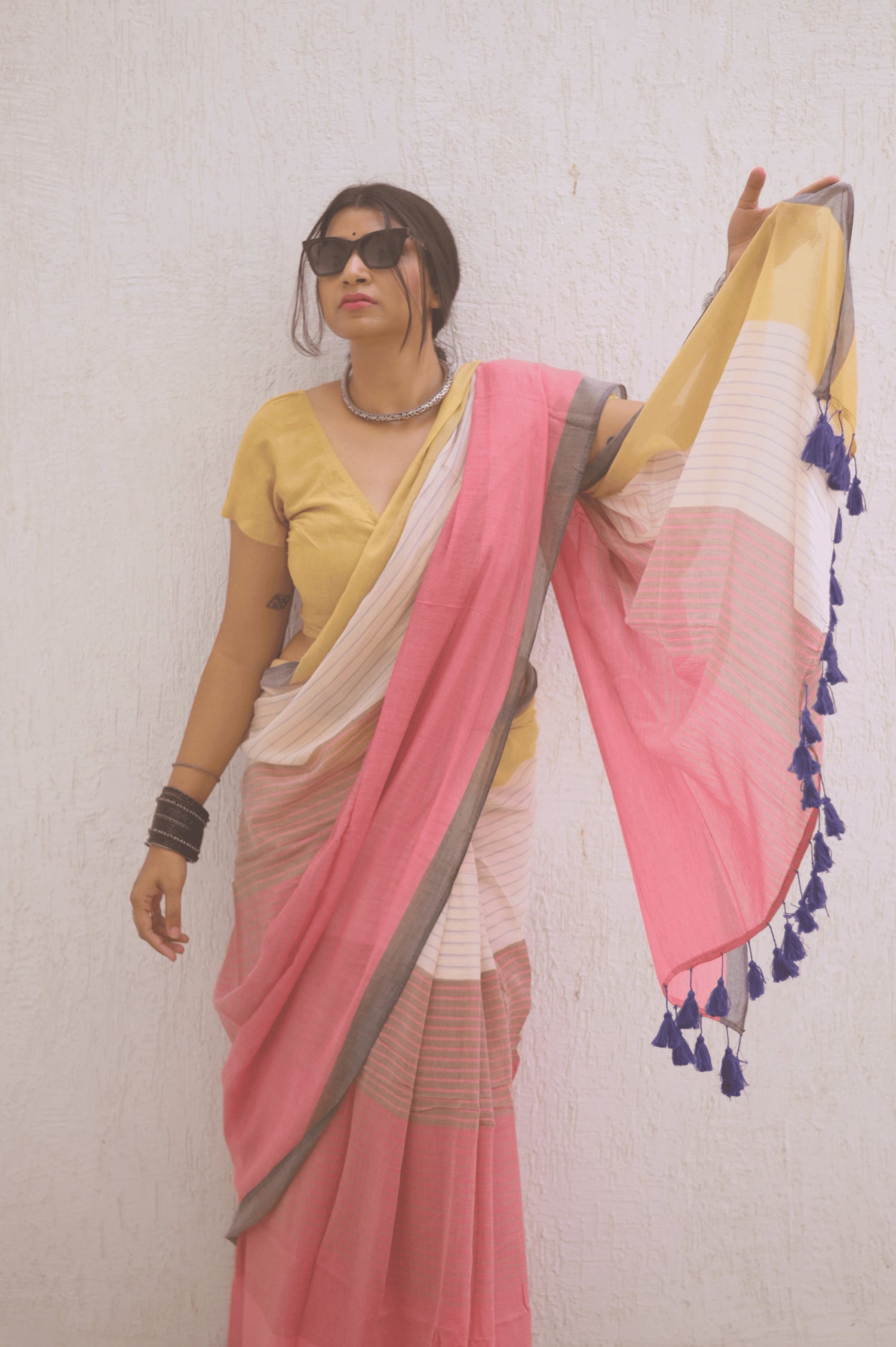


Bharatanatyam Practice Saree: Fabric, Length, Borders and How to Buy

A Bharatanatyam practice saree is a plain, sturdy cotton saree, usually about 5.5 to 6 metres long with a contrast border, that dancers tie firmly over a fitted pyjama for class and rehearsals. It is cheap, washable and meant to take hours of araimandi, jumps and floor work, which is why it is a different thing from the stitched silk costume worn on stage. This guide covers how to choose one: fabric, length, border and colour, what goes underneath, how it is tied in class, and how to keep it fresh after sweaty sessions, including when you are buying ahead of the December Margazhi season.
What a Bharatanatyam Practice Saree Is
In most Bharatanatyam classes, older students and adults practise in a saree tied tightly round the body rather than in the stitched costume. Some schools start very young children in a simpler practice set and move them to the saree as they grow, so ask what your class expects. The full costume is kept for performances and dress rehearsals.
The practice saree has three jobs. It lets the teacher see the line of the legs and the depth of the araimandi (the half-sitting position). It trains you to move in a saree, so a costume feels familiar on the day. And it has to survive daily washing. So it is usually a plain or simply bordered cotton, with no heavy zari, mirror work or loose threads that might catch.
Cotton or Synthetic for Class
Cotton is the default, and for good reason. It breathes, absorbs sweat and grips when tucked, so pleats and the tied end stay put through a class. Dance tailors that make practice wear recommend cotton and warn against fabrics that trap heat and limit movement. For the many kinds of cotton saree and how they differ, see our guide to types of cotton sarees; here is what matters for dance.
Within cotton, look for a medium, firm weave. A very fine, sheer cotton feels lovely but can cling and show the pant through it when damp. A thick, starchy handloom cotton is hard to tuck tightly. Some dancers like sturdy regional cottons such as Chettinad cotton for practice, because the weave is firm and the borders are bold.
How Long a Practice Saree Should Be
Most practice sarees sold for class are about 5.5 to 6 metres long, with a few sold as extra length for taller dancers. There is no single standard, and some teachers ask for a longer saree so the pleats are deep enough. Taller dancers, and anyone whose class uses a drape that passes between the legs, usually need the longer end of the range. For general saree sizes and how length relates to height, see our saree length and size guide.
The older dance costume was much longer. The devadasi performers who danced before the 20th-century revival wore a nine-yard silk saree with contrasting borders, pleated in front with the end over the left shoulder, according to a dance costume module on INFLIBNET e-PG Pathshala. Today's practice saree is closer to the everyday six-yard length.

Width matters too. If you are tall, check the width before buying, since the saree has to reach from your waist to just above the ankle once tied high.
Borders, Colours and Class Colours
The classic practice saree is a solid body with a contrast border, such as red with a mustard border or green with a blue border. The border is useful, not just pretty: it marks the edges of the pleats and the hem, so the teacher can see whether your knees are opening out in araimandi and whether your lines are clean.
Dance wear colours have moved over the decades from sharp, bright shades towards softer tones, and muted cotton is common now. Many schools set a class colour for group practice or for rehearsals, so check before you buy. If there is no rule, a mid to dark colour hides sweat marks and floor dust better than white or pastel. Plain white with a coloured border is traditional in some classes, but it shows every mark.
Temple borders, with their triangular points, also turn up on practice sarees. Our temple border saree guide explains the motif.
What to Wear Underneath
A practice saree is not usually worn over a petticoat. Instead it is tied over a fitted practice pant: a cotton pyjama gathered at the ankle, leggings, or a churidar-style pant. The pant keeps you covered in araimandi, jumps and floor sitting, and gives the saree a firm waistband to tuck into. Younger children sometimes wear a knee-length half pant under a short practice set. Your school will usually say which.
For plain cotton blouse ideas that work under a practice saree, see blouse designs for plain cotton sarees. Keep the neckline modest and the fit snug: a loose blouse rides up when you raise your arms.
How It Is Tied for Practice
Teachers usually show the drape in the first class, and schools differ, so follow yours. In outline, most practice drapes start like an ordinary saree but are tied higher and much tighter. The pleats go in at the centre front, the pallu goes over the left shoulder, and then the end of the pallu is brought round the body and tucked or tied firmly at the waist, so nothing hangs loose.
Some schools go further and take the back of the pleats, or a section of the saree, between the legs and tuck it in at the back, in a style related to the old kaccham drape. This frees the legs for deep araimandi and stops the pleats from trapping the knees. It also uses more length, which is one reason some classes ask for a 6 m saree.
For standard pleating technique, which carries over to class, see how to make saree pleats.
Practice Saree vs Performance Costume
The stage costume is a stitched outfit that only looks like a saree. Research on the form describes how the stitched pyjama costume, loose trousers with a knife-pleated fan between the legs, evolved during the 1930s, alongside skirt and saree styles that are cut and stitched to look draped. These are usually silk, made to measure, and worn with temple jewellery.
Between the two sits the readymade practice saree: a cotton set stitched into a pant or skirt with a pleated front, fastened with a drawstring or velcro. As of 2026 they usually cost several times more than a plain practice saree, roughly ₹2,000 or more at dance tailors. They save time, but many teachers prefer students to learn to tie a real saree first.
Some dance schools also use a half saree (davani) set for practice. For how a half saree is put together, see our half saree guide.
Buying for Class and the Margazhi Season
Margazhi, the Tamil month from mid-December to mid-January, is when Chennai's music and dance season runs, with performances at sabhas, temples and schools (Tamil Nadu Tourism). For students it often means extra rehearsals, group items and demonstrations, so this is when practice sarees wear out fastest and when shops near dance schools are busiest.
Washing After Sweaty Classes
A practice saree soaks up a lot of sweat. Washing it soon, rather than leaving it balled up in a bag overnight, is the single best thing you can do for its smell and colour. For general cotton care, see how to wash cotton, chiffon and linen sarees.
If a saree starts to fade or thin at the knees and seat, move it to home practice and keep a newer one for rehearsals and group items.
Sarees for Concerts and Home Practice
These MAYIN sarees are not class practice sarees: they are soft mul cotton and mul modal, lighter than a firm practice cotton and better for wearing to Margazhi concerts, or for practising a regular drape at home. Each is 5.5 m long and 45 inches wide, and all four take a gentle cold hand wash. Bright Side has the white body and yellow border of a traditional practice look, and Dusty Petal is a small gingham check; both come without a blouse piece. Mauve Melody and Cocoa are plain mul modal with a 1 m running blouse piece in the same fabric. Free delivery in India on orders of ₹2,000 and above.


Browse more in mulmul cotton sarees and border sarees.
Questions People Ask
What is a Bharatanatyam practice saree?
It is a plain, firm cotton saree, usually 5.5 to 6 m long with a contrast border, tied tightly over a practice pyjama for class. It is separate from the stitched silk costume worn on stage.
Which fabric is best for a Bharatanatyam practice saree?
Cotton, in a medium, firm weave. It breathes, absorbs sweat and stays tucked; polyester traps heat and slips.
How many metres is a practice saree?
Usually about 5.5 to 6 m. Tall dancers, and classes that use a between-the-legs drape, often need 6 m or a little more.
What do you wear under a Bharatanatyam practice saree?
A fitted cotton practice pyjama or leggings, a snug cotton blouse and a supportive bra. A petticoat is not usually worn.
Can I wear a normal saree for Bharatanatyam practice?
An ordinary cotton saree of the right length can work for a first class. Sheer, slippery or heavily worked sarees do not, because they cling, slip or catch.
How do you tie a saree for Bharatanatyam practice?
Usually high and tight: pleats at the centre front, pallu over the left shoulder, and the pallu end brought round and tucked or tied at the waist. Some schools also take part of the saree between the legs; follow your teacher.
Is a readymade practice saree allowed in class?
Some schools allow them, especially for children; others want students to learn to tie a real saree. Ask your teacher before buying.
What is the difference between a practice saree and a Bharatanatyam costume?
The practice saree is one unstitched cotton length tied for each class. The costume is a stitched silk outfit with a pant or skirt, a pleated fan and a separate pallu, made to measure.
How much does a Bharatanatyam practice saree cost?
As of 2026, roughly ₹600 to ₹1,000 for a plain cotton practice saree in India. Stitched readymade sets usually cost roughly ₹2,000 or more.
How often should I wash my practice saree?
Ideally after every class, or at least after every two. Air it straight away and wash in cold water, keeping new or dark colours apart at first.
Why does my practice saree keep coming loose?
Usually the tie is too low or the fabric is too slippery. Tie it higher over a firm pant waistband, use cotton, and pin the pleats and the pallu end.


