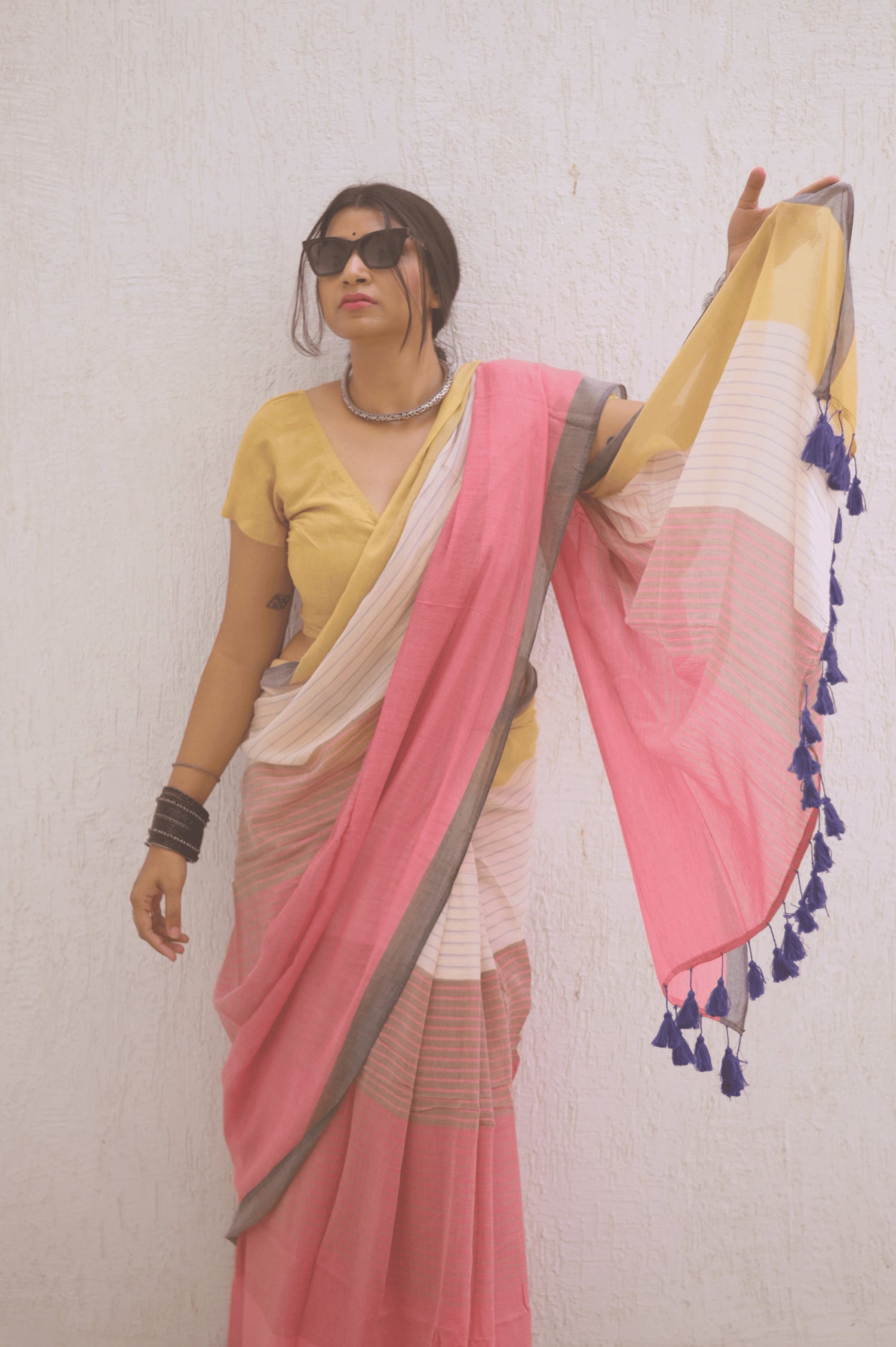


Kuppadam Saree: The Chirala Weave, Its Interlocked Border and How to Buy One

A kuppadam saree is a handloom saree from Chirala in Andhra Pradesh, woven with a cotton or silk body and a contrast silk or zari border that is interlocked into the body on the loom rather than stitched on. The name comes from the kuppadam (also written koopadam or kupadam) interlocking method, which lets a single weaver join a border of a different colour and yarn to the body, thread by thread. This guide explains where the weave comes from, how the border is made, the difference between kuppadam pattu and kuppadam cotton, how to check a genuine one, and how to wear and care for it.
What a Kuppadam Saree Is
Kuppadam is a weaving method first, and a saree name second. In a kuppadam saree the border is not a separate strip sewn to the edge, and it is not a printed band. It is woven at the same time as the body, often in silk or with zari, and locked into the body along the full length of the saree. That is what lets a plain cotton body carry a bright silk border in a completely different colour.
According to the Bapatla district administration, the method came to Chirala from Tamil Nadu, where it had been used mostly for borders on dhotis, and Chirala weavers took it up for sarees between 1998 and 2000. Chirala weavers then made the borders much wider, from about an inch on the dhotis to as much as 12 to 15 inches, and added temple motifs that made the sarees popular for rituals and ceremonies. Today the district lists kuppadam sarees as its One District One Product, and in 2025 they were chosen for a national ODOP award.
Where Kuppadam Sarees Are Woven
Chirala, a coastal handloom town now in Bapatla district (earlier part of Prakasam district), is the centre most closely tied to the name. Weavers and their societies work from localities in and around the town such as Devangapuri, Kothapeta, Ramakrishnapuram, Jandrapeta and Hastinapuram. Chirala looms are mostly pit looms, and Chirala also weaves ordinary cotton sarees and silk and cotton sarees, so not every Chirala saree is a kuppadam.
The interlocked weft itself is older and wider than Chirala. Gadwal sarees from Telangana are traditionally woven in an interlocked weft technique also called kupadam, with a cotton body and silk borders, and weaver groups elsewhere in Andhra Pradesh also sell cotton sarees described as kuppadam weave. When a seller says only "kuppadam", ask where it was woven. Our Gadwal saree guide covers that weave in detail.
How the Interlocked Border Works
On an ordinary loom one weft thread runs from edge to edge, so the body and border share the same crosswise yarn. Only the warp, the lengthwise threads, can change colour. That is why simple borders on many cotton sarees are warp stripes in the same weft colour as the body.
An interlocked weft works differently. The body has its own weft shuttle and each border has its own. The body weft travels across the body and turns back where the border begins. The border weft travels across the border and turns back at the same line. At that meeting line the two wefts loop round each other, so the border can be silk while the body is cotton, and the border colour can be completely different from the body.
Because every pass has to be interlocked by hand, the weaving is slower than a plain cotton saree. That extra work is part of what you pay for, and it is the first thing to check when buying. If you want the bigger picture of temple and contrast borders, see our temple border saree guide.
Kuppadam Pattu vs Kuppadam Cotton
Both use the same interlocked border. The difference is the yarn in the body, and that changes the weight, the price, the occasions and the care. Sellers use "pattu" for silk, and sometimes loosely for silk and cotton mixes, so always read the full fabric line.
If you are torn, think about heat and hours. A kuppadam cotton is the easier choice for a long day in a warm city. A kuppadam pattu reads more formal and photographs with more shine. For a wider look at silk names, read our pattu saree guide.
Kuppadam Compared With Similar Weaves
Kuppadam is often confused with other South Indian sarees that have contrast borders. These are the ones it gets mixed up with most.
So a kuppadam can look like a lighter cousin of a korvai silk, and Gadwal and kuppadam share the same family of technique. Read more in our guide to the Kanchi cotton saree.
How to Identify a Genuine Kuppadam Saree
No single test proves a kuppadam saree, but a few checks together tell you a lot. Do them in daylight, with the saree open on a table.
Our guide to Silk Mark and Handloom Mark explains what each label covers, and the handloom saree guide has more ways to tell handloom from power loom.
When to Wear a Kuppadam Saree
The temple motifs and auspicious colours mean kuppadam sarees are often chosen for pujas and ceremonies. The light cotton versions also work every day. Here is a simple way to match the saree to the day.
For a temple day, keep the drape simple and pin the pallu so it does not slip when you sit or bend; our saree for temple visit guide covers what to wear and carry.
Blouse Ideas for a Kuppadam Saree
A kuppadam saree is built on contrast, so the blouse usually works best in either the border colour or the body colour, not a third colour. Before cutting anything, check whether a blouse piece is included and where it sits in the length.
For cut ideas, see our blouse designs for cotton sarees.
Washing, Ironing and Storing
The care rule follows the most delicate part of the saree, which is usually the silk and zari border. Cotton bodies can shrink a little and contrast borders can bleed, so be careful with the first wash.
Our guide on how to clean a zari saree goes into more detail.
Sarees in This Guide
These MAYIN sarees are not kuppadam weaves. They are lighter alternatives for the same look of a plain body with a woven or zari border, in handloom linen and mul cotton. Every MAYIN saree is 5.5 m long and 45 inches wide. The linen sarees cost ₹4,499 and come with a 1 m blouse piece; mul cotton sarees come without a blouse piece. Delivery is free in India on orders of ₹2,000 and above.
 Main EventBurgundy red pure handloom linen with zari borderPair with Gold, maroon, cream
 On RepeatYellow handloom linen with zari borderPair with Gold, green, maroon
 ComposurePink pure handloom linen with zari borderPair with Gold, maroon, ivory
 Bright SideWhite mulmul cotton with yellow borderPair with Yellow, red, green
 ManjariRed striped mul cotton zariPair with Gold, green, cream
 EmeraldGreen striped mul cotton zariPair with Gold, maroon, pink
The linen and zari sarees are dry clean only. Bright Side takes a gentle cold hand wash. See more in our zari sarees and linen sarees.
Questions People Ask
What is a kuppadam saree?
It is a handloom saree, mainly from Chirala in Andhra Pradesh, with a silk or zari border that is interlocked into a cotton or silk body as it is woven. The name comes from the kuppadam interlocking method.
Where are kuppadam sarees made?
Chirala in Bapatla district, Andhra Pradesh, is the main centre. Similar interlocked weft sarees are also woven at Gadwal in Telangana and by some other weaver groups in Andhra Pradesh.
Is kuppadam saree pure silk?
Not always. A kuppadam pattu has a silk or silk and cotton body, while a kuppadam cotton has a cotton body with a silk or zari border. Check the fabric line and ask for a Silk Mark label for silk.
What is the difference between kuppadam pattu and kuppadam cotton?
Both use the same interlocked border. Pattu has a silk body with more sheen and weight, while cotton has a matte, lighter body that suits long days and warm weather.
Is kuppadam the same as Gadwal?
They share the interlocked weft technique, and Gadwal is traditionally described as a kupadam weave. They are different weaving centres, with Gadwal in Telangana and kuppadam sarees mainly from Chirala in Andhra Pradesh.
Does kuppadam saree have a GI tag?
An application for Chirala Kuppadam Sarees was filed in February 2026. As of November 2026 the registry shows it at pre examination, so it is not yet registered.
How can I tell an original kuppadam saree?
Look for a visible interlocked join where the body weft turns back at the border, and check that the border has its own weft rather than the body weft running through it. On the reverse, handwoven motifs show as threads running across the width.
Can I wash a kuppadam cotton saree at home?
Dry clean it the first time. After that a cotton body can usually take a short cold soak on its own with mild detergent, without wringing or rubbing the zari.
Are kuppadam sarees heavy?
Kuppadam cotton is light and easy for daily wear. Kuppadam pattu with a wide zari border is heavier, though usually lighter than an all silk saree of similar design.
Which blouse suits a kuppadam saree?
A blouse in the border colour is the classic choice, often with a strip of border on the sleeve. A body colour blouse is quieter for office wear.


