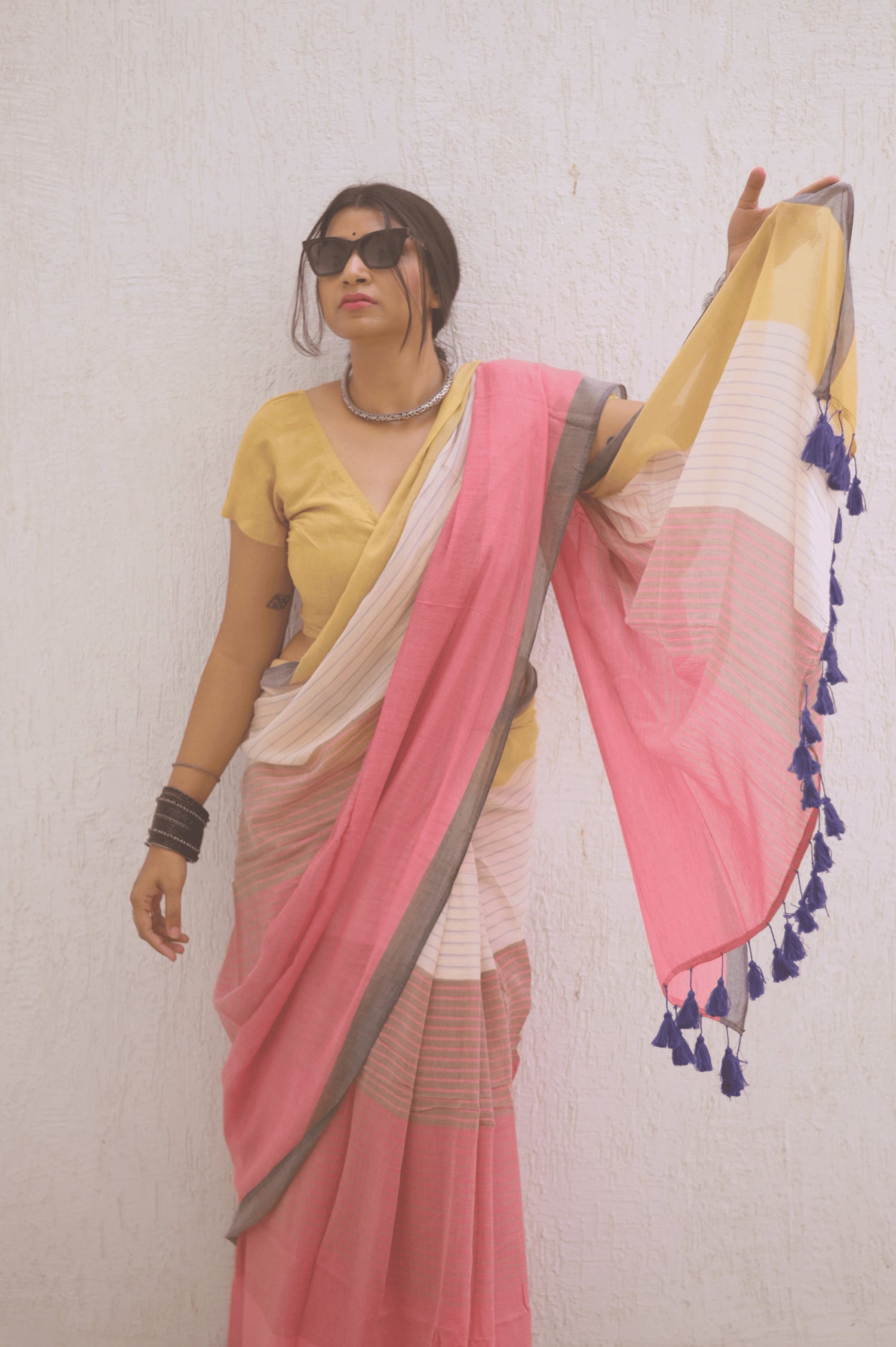


Tangail Saree: Origin, the 2024 GI Dispute, Weave, Price and Care

A Tangail saree is a light, handwoven cotton saree from Bengal, with a fine body scattered with small woven motifs called buti and a decorated border and pallu. It began in Tangail district in present-day Bangladesh, and after Partition many of its weavers settled in Phulia and nearby villages of West Bengal, so today it is woven on both sides of the border. This guide explains where the weave came from, why India and Bangladesh both claimed it in 2024, how the motifs are woven, how it differs from jamdani and tant, how to tell a real handloom piece, what it costs, and how to wear and care for one.
What Is a Tangail Saree
The name comes from a place, not a technique. Tangail is a district north-west of Dhaka, and the saree is the fine cotton cloth its weaving families have made for generations. What sets it apart from other Bengal cottons is the decoration: small motifs are woven into the body with extra weft threads while the cloth is on the loom, so the pattern is part of the fabric, not printed or embroidered on top.
A typical Tangail feels light, smooth and slightly crisp, because the yarn is fine and the cloth is starched during weaving. The body is often a soft or pale colour, the buti are spaced across it, and the border and pallu carry most of the colour and pattern. Silk, tussar and blended versions exist too, but cotton is what most people mean by a Tangail.
From Tangail to Phulia: Where the Weave Comes From
The weavers of Tangail are usually described as descendants of the muslin weavers of the Dhaka region, first based around Dhamrai and Chauhatta. Reporting on the weave says that in the late 18th and 19th centuries local landowners invited skilled weavers, mostly from the Hindu Basak community, to settle in Tangail and make a fine, smooth saree. For a long time the craft stayed inside families, passed from parent to child.
Partition in 1947 changed that. Many Basak weavers left what became East Pakistan for West Bengal, and a second wave followed around the 1971 war. Some first worked on other weavers’ looms in Shantipur, Dhatrigram and Samudragarh before setting up their own. Over time, a cluster formed in Phulia and Santipur in Nadia district, and in Dhatrigram and Samudragarh in Purba Bardhaman, roughly 100 km north of Kolkata.
In Bengal the weavers combined the Dhaka-Tangail style with the local Shantipur loom saree, so the West Bengal Tangail grew into its own thing. From around the 1950s, weavers in Phulia began adding curvier motifs and even human figures, a style often called figure jamdani. Bangladeshi Tangail, meanwhile, kept to its own design language, and is still woven by Hindu Basak and Muslim Jhola weaving families in Tangail.
The 2024 GI Dispute, Explained
A GI, or geographical indication, is a legal label that ties a product to the place it comes from. Our guide to GI tag sarees explains how they work in India. The Tangail saree became one of the most argued-over GIs between India and Bangladesh.
The core of the disagreement is simple. Bangladesh says a product named after a place in Bangladesh should belong to Bangladesh. The Indian side rests on the weaving families who moved to Bengal and carried the craft with them, and on the way the weave has developed there since. Both versions are real handloom traditions with a shared root.
How a Tangail Saree Is Woven
Tangail is a cousin of jamdani. Both use a supplementary or extra weft: alongside the ordinary weft thread that makes the cloth, the weaver lays in a separate, often thicker or coloured thread only where a motif should appear. In the Bengal GI description, the extra weft goes in at a ratio of 1:2, so there are two plain ground picks for every motif pick. That is part of why a Tangail is quicker to weave and its motifs sit further apart than in a fine jamdani.
Look closely at the edge of a woven motif and it is slightly stepped, like a pixelated outline, because each colour change follows the grid of warp and weft. A printed motif has smooth edges and sits only on the surface.
Tangail vs Jamdani vs Tant
All three come from Bengal, all three are usually cotton, and the names get mixed up in shops. Here is how they differ, in short. For the full stories, read our Dhakai jamdani guide and our tant saree guide.
A quick way to remember it: tant is the crisp daily cotton, jamdani is the slow, fine heirloom weave, and Tangail sits between them, with jamdani-style motifs on a lighter, more affordable cloth. Bengal weavers often call Tangail a simplified form of jamdani.
How to Spot a Real Handloom Tangail
Cheap power loom copies of Tangail designs are common, and a simple handloom Tangail can take about a day to weave, while a power loom can turn out several in the same time. Most of the clues are in the motif and the edges.
Tangail Saree Price Guide
Price follows yarn fineness, how much of the motif work is laid by hand, and the fibre. As of 2026, roughly:
These are rough bands that vary by city and seller. Anything sold as a handloom Tangail at power loom prices, with a perfectly even print-like pattern, deserves a careful look at the back. Our handloom saree guide explains why handwoven sarees cost what they do.
How to Style a Tangail Saree
A cotton Tangail is a day saree: office, college, a puja morning, Pohela Boishakh, a family lunch. Richer naksha and silk Tangails move up to evening pujas and smaller weddings. Because the cloth is light, it is comfortable in heat and humidity, and the buti give it more interest than a plain cotton.

For a traditional look, try the Bengali drape shown above. Tuck the saree at your right hip and wrap it once, with no pleats or just two or three wide folds. Take a pleated pallu over the left shoulder and let it hang longer than in the nivi. Bring the end round under the right arm and lift it over the right shoulder, then tie a bunch of keys to it or pin a brooch. Our Bengali saree look guide covers the jewellery and make-up that go with it. For office days, the usual nivi drape with the pallu over the left shoulder works well.
Caring for a Tangail Saree
A new Tangail is stiff from its starch and may release some dye at first, so the first wash matters most. Many people dry clean a new or heavily worked piece the first time. For plain and lightly worked cotton Tangails, a gentle hand wash usually works well.
Store it folded in a cotton or muslin cloth, away from damp, and refold it along different lines every few months so the creases do not weaken the fine yarn. Silk and tussar Tangails, and any piece with zari, are best dry cleaned. For more on cotton care, see our guide to washing cotton, chiffon and linen sarees.
Sarees in This Guide
MAYIN sarees are not Tangails, so these are lighter alternatives that share something with the weave. Lilac Bloom is an Original Dhakai jamdani with lavender floral motifs, the closest cousin to a butidar Tangail (₹4,999, no blouse piece, dry clean). Bright Side is a white mul cotton saree with a yellow border, an easy Bengal-style day saree (₹1,999, no blouse piece, gentle cold hand wash). Our handloom linen sarees, such as Main Event and Crosswalk, give the same handwoven texture with more body (₹4,499, with a 1 m blouse piece, dry clean). For a festive alternative, Miss Earth is a handloom tissue saree with a zari border (₹3,499, no blouse piece, dry clean). Every MAYIN saree is 5.5 m long and 45 inches wide, and delivery in India is free on orders of ₹2,000 and above. Browse more jamdani sarees and handloom sarees.
 Lilac BloomLavender floral original dhakai jamdaniPair with White, purple, silver
 Bright SideWhite mulmul cotton with yellow borderPair with Yellow, green, red
 Main EventBurgundy red pure handloom linen with zari borderPair with Gold, cream, black
 CrosswalkMulticolour striped pure handloom linenPair with White, navy, mustard
 Miss Earth Tissue SareeMiss earth tissuePair with Yellow, gold, cream
Questions People Ask
What is a Tangail saree?
A light handwoven saree, usually cotton, with small woven motifs called buti on the body and a patterned border and pallu. It is named after Tangail district in Bangladesh, where the weave began.
Is Tangail saree from India or Bangladesh?
It began in Tangail, Bangladesh. After 1947 and again around 1971 many weavers moved to Phulia, Santipur and nearby villages in West Bengal, so it is now woven in both countries.
Who got the GI tag for Tangail saree?
Both. India registered Tangail Saree of Bengal on 2 January 2024, and Bangladesh declared Tangail Saree a Bangladeshi GI product in February 2024, and in May 2024 said it would challenge the Indian registration.
What is the difference between Tangail and Jamdani?
Both use extra-weft motifs, but jamdani lays a motif pick after every ground pick and is finer and slower to weave. Tangail has two ground picks per motif pick, more spaced buti and a lower price.
Is Tangail saree pure cotton?
Most are cotton, often fine count yarn. Silk, tussar and blended Tangails are also made, so check the fibre with the seller.
Tangail vs tant saree, which is better?
They suit different needs. Tant is crisper and cheaper for daily wear; Tangail is lighter and finer, with woven motifs, and works for both day and festive wear.
What is the price of a Tangail saree?
As of 2026, roughly ₹600 to ₹1,500 for simple cotton ones near the loom, ₹2,000 to ₹5,000 for richer handloom cotton, and ₹5,000 and above for fine nakshi buti or silk pieces.
How can I identify an original Tangail saree?
Turn it over: handwoven buti show on the back with trimmed ends. The motifs feel slightly raised, vary a little, and have stepped edges, and a good seller can name where it was woven.
Is Tangail saree good for summer?
Yes, a cotton Tangail is light and breathable, which is why it is popular for humid Bengal summers and Puja days.
How do I wash a Tangail saree?
Dry clean it the first time if it is new or heavily worked. After that, plain cotton ones can usually be washed gently by hand in cold water, alone, dried in shade and ironed on the reverse.
What is Phulia Tangail?
It is Tangail woven in Phulia in Nadia district, West Bengal, mainly by families who came from Tangail after Partition. It is often softer than a jamdani, with more widely spaced motifs, and includes figure designs.


