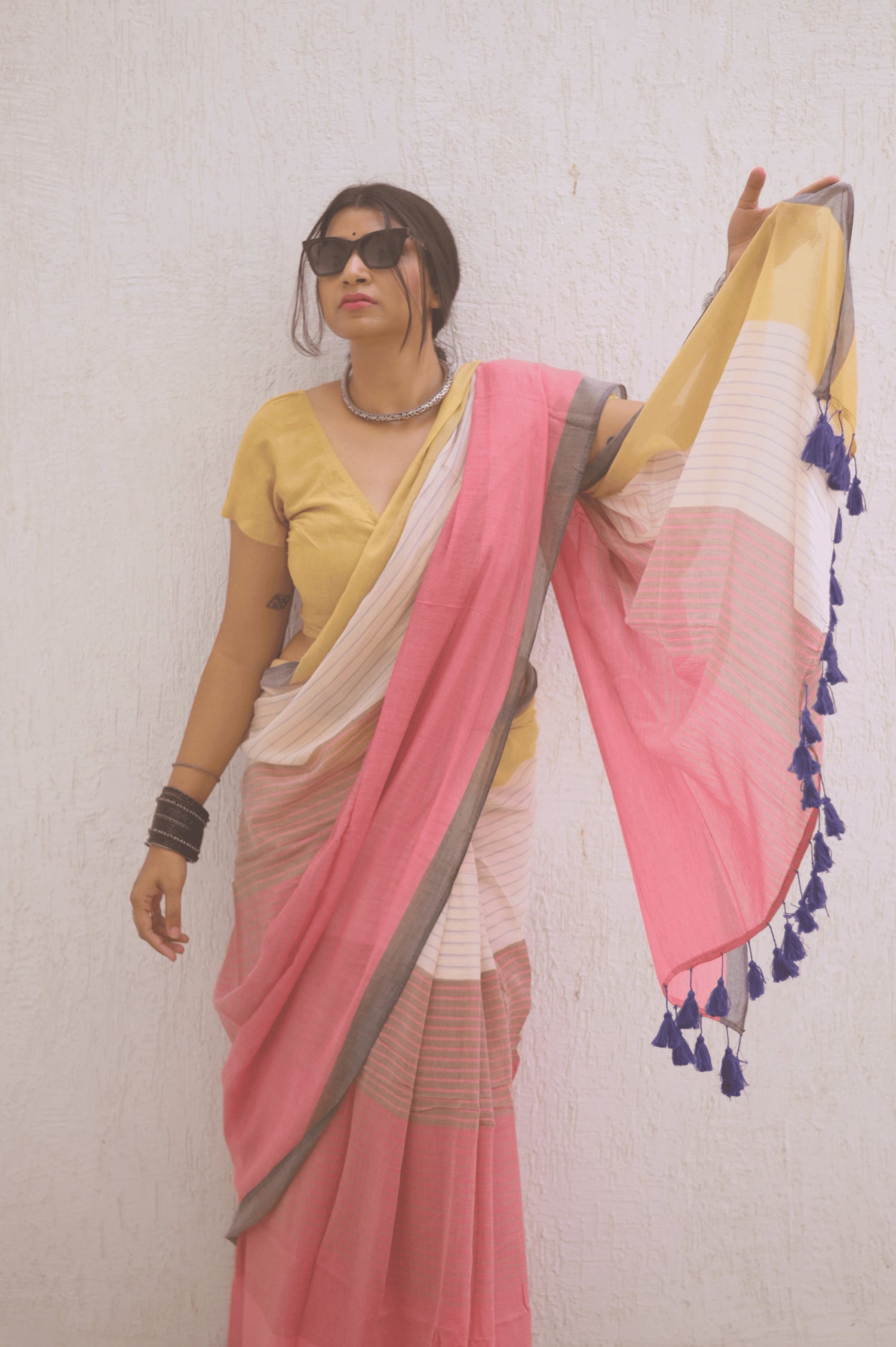


Sarhul Saree: What to Wear for the Sal Blossom Festival of Jharkhand

The Sarhul saree is a white or off-white saree with a red border, worn by Adivasi women of Jharkhand and neighbouring states for Sarhul, the spring festival that honours the sal tree and marks the new year. It is usually a plain handloom cotton, sometimes tussar, draped so that you can walk in a procession and dance for hours. This guide explains the festival, the 2027 date, what the red and white is understood to mean, where the sarees are woven and how to wear one well, with the care a sacred festival deserves.
What Sarhul Is and Who Celebrates It
Sarhul is the spring and new year festival of the Adivasi communities of the Chotanagpur plateau. It falls when the sal tree (Shorea robusta) flowers, and the sal is at the centre of everything: it is held to be the home of the village protecting deity, and its blossoms are offered, shared and carried in the dance. Worship happens at the Sarna Sthal, the sacred grove, with no idols. The village priest, the pahan, leads the rites. In many accounts the pahan stands for the sun and his wife, the pahen, for the earth, and the festival celebrates their union and the renewal of life.
It is a farming festival too. Ploughing and sowing for the new season usually begin only after the Sarhul rites are done. The festival is part of the Sarna faith that many Jharkhand Adivasi communities follow, which is why it carries real religious weight, not only colour and music.
Sarhul is celebrated across Jharkhand and in Adivasi villages of Chhattisgarh, Odisha and Bihar. Families whose ancestors moved for work, including to the tea gardens of Assam, keep it too. The largest public gathering is in Ranchi, where town processions have been held since the 1960s and the Siram Toli Sarna Sthal is a major gathering place.
When Is Sarhul in 2027
Sarhul follows the lunar calendar. It begins on the third day after the new moon of Chaitra, so the date moves each year between late March and mid April. In 2027 it is expected on Friday, 9 April, which is the date published holiday calendars give. Check the Jharkhand government holiday list once it is published, because villages may also hold their rites on a day the pahan fixes locally, and some communities keep celebrating for weeks after.
So the saree is usually worn on day two, for the puja and the procession, and often again on day three. Plan for two outfits if you will be there for both, since a cotton saree after a day of dancing in April heat will need a wash.
Why a White Saree With a Red Border
Women wear a white or off-white saree with a red border for Sarhul, and men wear a white dhoti with a red border, often with a white vest and white turban. In Jharkhand the red and white saree is widely seen as a marker of Adivasi identity, and it is the same pair of colours used for the flags at the sacred grove. You will hear it called a laal paar or laal padh saree, simply "red border".
There is no single official meaning, and explanations vary by village and speaker. A few you will come across:
The border width is a matter of taste and of what the weaver makes. Narrow red stripes, a wide solid band, or a red border with small woven motifs are all common. Some also carry red bands across the pallu. What matters is the red and white, not a particular weave.
Cotton or Tussar: Choosing the Fabric
Cotton is the everyday choice and the right one for most people. Sarhul falls in the hot, dry weeks of March and April, the procession can go on for hours on foot, and dancing in a line means a lot of movement. Cotton breathes, takes sweat, and can be washed at home. Tussar, the wild silk with a natural honey gold colour, suits those who will spend more time at the puja than in the dance, and the cooler early morning. For how tussar is made and how to tell real tussar, see our tussar silk saree guide.
A new saree is a common wish, but not a rule. If yours is new, wash it once before the day to remove the starch, and check that the red does not run onto the white. To learn the signs of a real handloom and the Handloom Mark, read our handloom saree guide.
Buying a Saree Woven in Jharkhand
Jharkhand is India's largest producer of tasar (tussar) silk, with recent estimates putting its share at roughly two thirds to three quarters of national output, and the Central Tasar Research and Training Institute is in Ranchi. Bhagaiya, a village in Godda district, is so known for handloom silk weaving that it is called Resham Nagar, silk town. Tribal textiles such as the parhan and panchi, striped and checked handwoven cloths, are part of the same living tradition, and state government programmes support weavers with training, design and sales.
Handloom red border sarees are also woven in Bengal and Odisha, and you will find them in the same markets. For the cotton weaves of Bengal see our Bengal cotton saree guide, and for Odisha see the Odisha saree guide.
How to Wear the Saree for the Dance
Sarhul dancing is done in groups, and in town processions people dance as they walk, sometimes for miles. The drape has to stay put, leave your feet free and keep the pallu from slipping. Many Adivasi women have their own family way of draping; if you are joining a group, ask how the others wear it and follow them. If you are wearing the nivi drape, these changes help.

For the pins themselves, and how to hide them, see how to pin a saree. Carry two spare safety pins and a small towel. Wear flat footwear with a back strap, since processions can be long and the ground at the grove may be uneven. Do your hair before you drape, so you can fix flowers in it without disturbing the pallu.
Blouse, Jewellery and Sal Flowers
The blouse is usually red, to match the border, or white or cream to match the body. A red blouse gives the strongest red and white look. A short or elbow sleeve is comfortable in April and hides sweat marks better than sleeveless. Keep the fit easy across the back and arms, since you will raise your arms in the dance. For more pairings see blouses for a white saree.
Women at Sarhul usually wear earrings, a necklace, wristbands or bangles and anklets. Silver and oxidised metal sit well with the red and white and do not compete with the border; our guide to oxidised jewellery with a saree has ideas. Keep pieces light and secure, since heavy earrings and long chains swing hard in a dance.
Flowers matter more than jewellery at Sarhul. Sal blossoms, the small cream flowers called sarai phool, are gathered in the forest, offered at the grove, given as a greeting and placed over doorways. Women often tuck flowers into the hair bun, and dancers carry sal flowers in their hands. If the pahan or your hosts give you sal flowers, wear them in your hair or keep them, and do not throw them away casually. A low bun holds flowers best under a pinned pallu.
Wearing It With Respect
Sarhul is a religious festival of the Sarna faith, and the red and white saree is tied to Adivasi identity. That does not mean an outsider cannot take part. Visitors are often welcomed at the processions and dances. It does mean the saree is not a costume, and the grove is a place of worship.
Sarees in This Guide
These are not laal paar sarees. They are lighter alternatives in the same colours: white and red cotton, modal and linen that suit a Sarhul gathering in the city, a family lunch or a visit as a guest. Each MAYIN saree is 5.5 m long and 45 inches wide.


Bright Side is a white mul cotton with a yellow border, with no blouse piece, and takes a gentle cold hand wash, so it can go straight from the procession into a bucket. Pair it with a red blouse for a red and white look. Gardenalia White is white mul cotton with floral embroidery, no blouse piece, and is dry clean. Main Event is a burgundy red pure handloom linen with a zari border at ₹4,499, with a 1 m blouse piece; it is dry clean. Regal Pin Drop is a maroon red mul modal with a 1 m running blouse piece in the same fabric, and takes a gentle cold hand wash. Delivery is free in India on orders of ₹2,000 and above. Browse more in white cotton sarees and red sarees.
Questions People Ask
What saree is worn on Sarhul?
Women usually wear a white or off-white saree with a red border, most often handloom cotton. Men wear a matching white dhoti with a red border.
When is Sarhul in 2027?
Sarhul 2027 is expected on Friday, 9 April, three days after the new moon of Chaitra. Check the Jharkhand government holiday list once it is published, as villages may also fix their own day.
Why do people wear red and white on Sarhul?
Red and white are the colours of the Sarna flags and a marker of Adivasi identity in Jharkhand. Meanings vary, but white is often linked to peace and purity and red to life, blood and sacrifice.
Which tribes celebrate Sarhul?
The Oraon (Kurukh), Munda, Ho, Santal, Kharia and Bhumij communities, along with Sadan people of the Chotanagpur region. Each has its own name for it, such as Khaddi, Baa Parab and Baha Parab.
Why is the sal tree worshipped at Sarhul?
The sal is held to be the home of the deity who protects the village, and it flowers at the turn of the year. Its blossoms are offered at the sacred grove and shared as a blessing.
What is the Sarhul dance called?
Sarhul dances are group dances, done in a line to dhol, nagara and mandar. Many accounts name Jadur, with related forms such as Gena and Por Jadur, but names and steps vary by community.
What is a laal paar saree?
Laal paar means red border. It is a white or off-white saree with a red border, worn in Jharkhand for Sarhul and, in a different tradition, in Bengal.
Is the Sarhul saree cotton or silk?
Most are handloom cotton, which suits the heat and the dancing. Tussar silk, of which Jharkhand is India's largest producer, is chosen by some, often by elders.
Can non-tribal people wear a red and white saree for Sarhul?
Visitors are often welcome at processions, and many hosts are happy to see guests in red and white. Follow your hosts' lead, buy from local weavers and treat the grove as a place of worship.
What flowers are worn at Sarhul?
Sal blossoms, called sarai phool. Women often tuck them into the hair bun, dancers carry them, and they are placed over doors on the last day.
What blouse goes with a Sarhul saree?
A red blouse to match the border, or white or cream to match the body. Short or elbow sleeves are the most comfortable for dancing in April.


