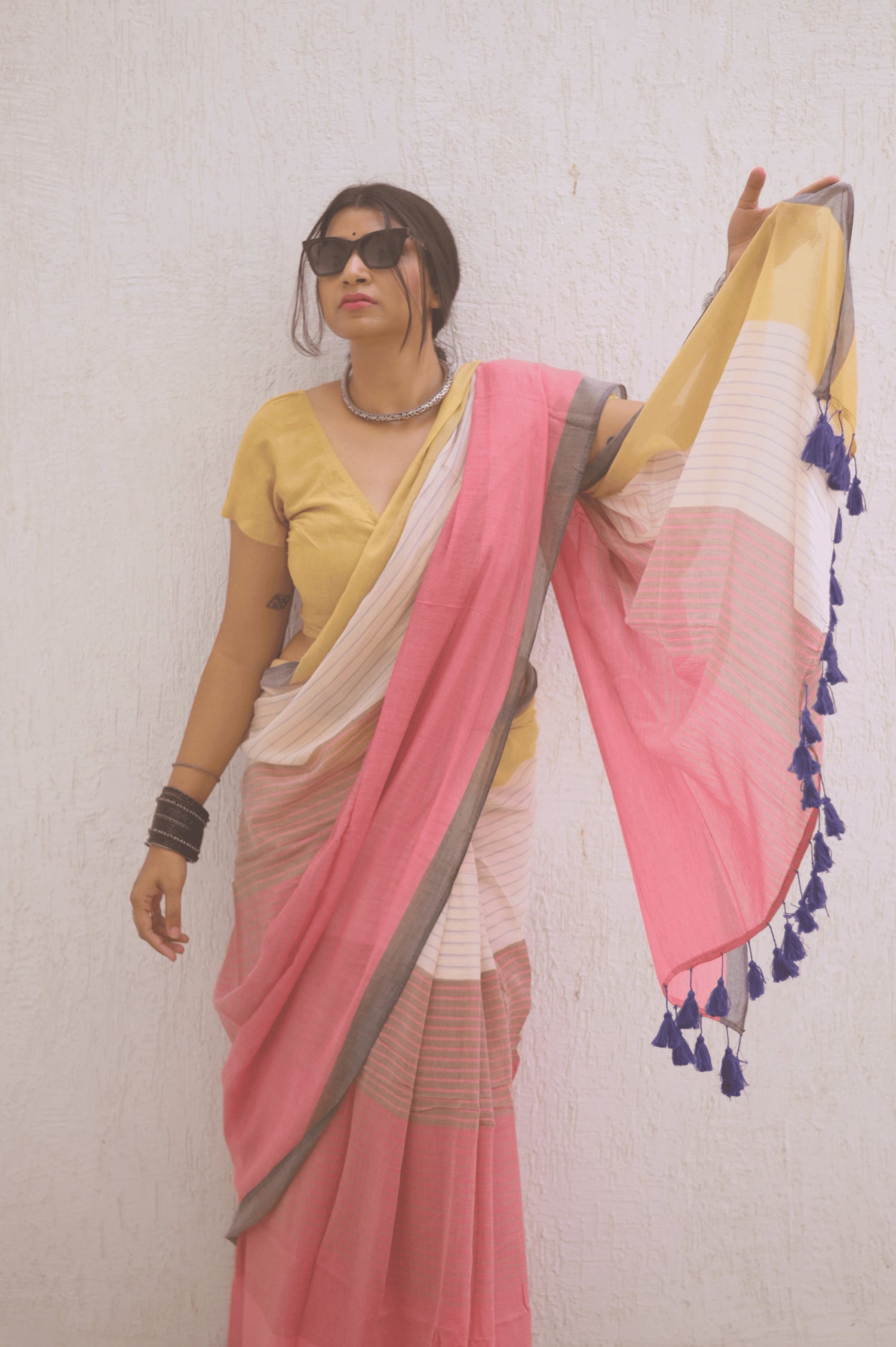


Pashmina Saree: Real Fibre, Blends, Prices, Labels and Winter Care

A pashmina saree, in the true sense, is a saree woven from pashmina: the very fine undercoat fibre of the Changthangi goat of Ladakh, spun and woven by hand in Kashmir. Most sarees sold as "pashmina" in Indian shops are not that. They are silk or cotton blends, ordinary wool, viscose or acrylic, or a Kashmiri-style woven pattern on a silk-cotton base, and the word is used as a name for a soft, warm look rather than for the fibre. This guide explains the real fibre, the GI and BIS rules that protect it, how pure, blended and trade-name sarees differ, what each roughly costs, how to check a label before you pay, and how to wear, wash and store a woollen saree so that moths do not get to it first.
What a Pashmina Saree Really Is
Pashmina is a fibre, not a weave or a pattern. It comes from the soft down that the Changthangi goat grows under its coarse outer hair to survive the winters of the Changthang plateau in eastern Ladakh. In the wider wool trade this kind of goat down is called cashmere. Pashmina is the finest end of it, and the name is tied, by law and by custom, to the fibre from this region that is cleaned, spun and woven in Kashmir.
So when you see "pashmina saree", there are really three things it can mean. It can mean a saree woven wholly from pashmina yarn, which is rare and costly. It can mean a blend, where pashmina is mixed with silk or another wool so the cloth is stronger and cheaper. Or it can mean a saree that has nothing to do with the goat at all, where "pashmina" is a selling word for something soft, warm or Kashmiri in style. All three are sold side by side, often at prices that do not match the label.
If the embroidery or the woven paisley is what drew you, that is a separate subject. Our Kashmiri saree guide covers tilla, sozni, aari and kani work in detail. This guide is about the cloth underneath.
From Changthangi Goat to Saree
The Changthangi goat is native to the high, cold Changthang region of Ladakh, where Changpa nomads herd it. According to the Ministry of Textiles, about 2,400 families rear roughly 2.5 lakh of these goats, and Ladakh produces about 50 tonnes of the finest grade of pashmina a year. The fibre measures roughly 12 to 15 microns across, far finer than ordinary sheep wool, which is why it feels so soft against the skin.
That length is the reason true pashmina sarees are uncommon. A weaver can finish a shawl far sooner than a saree, the yarn is costly, and a saree of very fine handspun yarn is delicate to drape and pleat. Many weavers therefore use a silk or fine wool warp for strength, which is one honest reason blends exist.
The Kashmir Pashmina GI and the BIS Standard
"Kashmir Pashmina" is a registered Geographical Indication. It appears in the GI register as application number 46, a handicraft from Jammu and Kashmir, registered in the 2008 to 2009 period. The application was filed by the Craft Development Institute in Srinagar, and it describes a fabric made from the fine undercoat of the mountain goat that is cleaned, spun and woven by craftsmen in the region. You can look the entry up on the GI registry public search. For other sarees with GI protection, see our state by state list of GI tag sarees.
In 2013 a GI label scheme was launched for hand-woven Kashmiri pashmina shawls. Pieces are tested at the Pashmina Testing and Quality Certification Centre in Srinagar for fibre, fineness, spinning method and weaving, and a tested piece carries a numbered label that can be checked online. In 2019 the Bureau of Indian Standards published an Indian Standard for identifying, marking and labelling pashmina products, released in Leh, to help stop blended or fake goods being sold as pure.
Pure, Silk-Pashmina, Wool Blend or Trade Name
This is the part that matters most when you shop. The same word covers very different cloths, and the fibre line on the label is what tells them apart.
Blends are not a cheat in themselves. A clearly labelled 70 percent pashmina and 30 percent silk saree, priced fairly, is an honest and practical cloth. The problem is a blend, or a cloth with no pashmina at all, sold as pure at a pure price. Independent tests reported in the Kashmir press have found pieces sold as pure pashmina that were mixed with sheep wool, angora or silk, and artisans have spoken publicly about machine-made imitations sold under the Kashmir name.
A useful rule: if the label says only "pashmina" with no percentage, read it as a style name until the seller tells you, in writing, what the fibre content is.
Feel, Warmth and Weight
Pure pashmina feels dry, warm and almost weightless in the hand. Crush a corner and it springs back slowly without sharp creases. The surface is matte rather than shiny, and against the light you can often see a faint fuzz of fine fibres. It warms quickly on the body because the fine, crimped fibres trap still air.
A silk-pashmina blend sits between the two. It has a little more drape and sheen than pure pashmina and holds pleats better, which many people find easier for a full day at a wedding. Woollen sarees of any kind do not hold crisp, flat pleats like cotton. Expect softer, rounder folds.
What a Pashmina Saree Costs
Prices vary with the fibre, the weave and any embroidery, and they are rarely printed beside the fibre content, so here are broad bands. They are approximate, as of 2026, and taken from current Indian listings, not a fixed rate card.
The simplest red flag is a "pure pashmina" saree at a four-digit price. Raw pashmina is scarce, hand spinning is slow, and a saree needs far more yarn than a shawl. A low price is not proof of fraud on its own, but it means the word pure needs explaining.
How to Check Before You Buy
No single home test proves a saree is pure pashmina. What you can do is rule out the obvious imitations and ask the right questions.
The burn test, and its limits
Some buyers burn a thread pulled from the fringe, never from the body of the saree. Do it over a sink or a steel plate, holding the thread with tweezers. Wool, including pashmina, and silk burn slowly and shrink from the flame. Wool smells like burning hair and silk like burning hair or charred meat; both go out on their own and leave a dark, crumbly bead you can crush to powder. Cotton and viscose smell like burning paper and leave a soft grey ash. Acrylic, nylon and polyester melt and leave a hard bead that will not crush.
This only separates animal fibre from plant or synthetic fibre. It cannot tell pashmina from ordinary sheep wool, and in a blend the results are mixed and hard to read. It also needs a seller who will let you take a thread. For anything costly, a lab report or a GI label is the only real proof.
Winter Styling, Blouse and Layering
A pashmina or woollen saree is a cold-weather saree: winter weddings and family functions in north India, evening events in the hills, and the diaspora winter. Its colours are often the natural shades of the fibre, ivory, fawn and grey, or deep dyed tones such as maroon, bottle green and navy. For a wider range of fabrics for cold days, see our winter saree looks and winter wedding saree guides.

For an extra layer over the saree, keep it simple: a long coat or a fine cardigan worn open over the pallu. Our guides to wearing a saree with a jacket and wearing a shawl with a saree cover the cuts and drapes in detail. With a pashmina saree a second heavy shawl is usually too much; the saree is already the warm layer.
Watch for friction. Handbag straps, a seat belt and the same spot on your hip rubbing against a chair are what make fine wool pill. Carry the bag in your hand and keep brooches and sequinned jackets away from the body of the saree.
Washing, Storage and Moth Protection
Pure pashmina and silk-pashmina sarees are safest with a dry cleaner who handles fine wool, especially if they have embroidery, zari or a printed pattern. Between wears, air the saree on a padded hanger for a few hours in shade before you fold it away. Wool recovers from creases when it rests.
If it needs pressing, use a low wool setting with a damp muslin cloth between the iron and the saree, or steam it lightly. Never press it directly.
Storing it through the summer
Clothes moths and carpet beetles prefer wool, and they breed in dark, undisturbed places. Museum textile conservators give the same basic advice for stored wool: keep it clean, keep it out of plastic, and disturb and check it regularly.
Our guide to storing silk sarees covers folding and muslin wraps in more depth, and most of it applies to silk-pashmina too.
Lighter Sarees for Cool Days
None of the sarees below is pashmina. If you want a saree for cool, not freezing, days, handloom linen and tissue are lighter options that layer with a thermal and a coat in exactly the same way. Every MAYIN saree is 5.5 m long and 45 inches wide. The linen sarees come with a 1 m blouse piece and are ₹4,499; they, the tissue and the jamdani are dry clean only. Free delivery in India on orders of ₹2,000 and above. You can browse more in our winter sarees and linen sarees collections.
 Main EventBurgundy red pure handloom linen with zari borderPair with Gold, black
 ComposurePink pure handloom linen with zari borderPair with Maroon, gold
 On RepeatYellow handloom linen with zari borderPair with Bottle green, maroon
 Corner OfficeMulticolour checked pure handloom linenPair with Navy, white
 CrosswalkMulticolour striped pure handloom linenPair with Black, mustard
 Miss Earth Tissue SareeMiss earth tissuePair with Maroon, gold
 Lilac BloomLavender floral original dhakai jamdaniPair with Purple, silver
For more on how fabrics compare across seasons, see our saree fabric guide and handloom saree guide.
Questions People Ask
What is a pashmina saree?
Strictly, it is a saree woven from pashmina, the fine undercoat fibre of the Changthangi goat of Ladakh, spun and woven in Kashmir. In shops the name is also used for blends and for soft sarees with no pashmina in them, so always read the fibre content.
Is pashmina wool or silk?
Pashmina is a wool, a very fine goat down of roughly 12 to 15 microns. A "pashmina silk" saree is a blend of pashmina with silk, or sometimes a silk saree with a Kashmiri pattern and no pashmina at all.
How can I tell if a pashmina saree is real?
Read the fibre percentage, ask for a GI label or test report for that saree, and look for the small irregularities of handspun yarn. A burn test on a fringe thread can rule out synthetics, but only a lab test can confirm pure pashmina.
What is the price of a pure pashmina saree?
As of 2026, handwoven pure pashmina sarees are rarely listed, and the few that are, usually embroidered, cost lakhs of rupees. Sarees labelled pashmina for a few thousand rupees are almost always blends or trade names.
Does a pashmina saree have a GI tag?
Kashmir Pashmina is a registered GI, application number 46, for Jammu and Kashmir. The GI label scheme was launched for shawls, so ask whether a particular saree has been tested and labelled.
Is a pashmina saree warm enough for a winter wedding?
Yes, pure pashmina and silk-pashmina are among the warmest saree fabrics for their weight. With a three quarter sleeve blouse and a thin thermal, most people need little else indoors.
Is a pashmina saree heavy?
Pure pashmina is light for the warmth it gives. Wool and acrylic versions are usually heavier, and silk blends sit in between.
What is the difference between pashmina and cashmere?
Both are goat down. Pashmina is the name used for the finest fibre from the Changthangi goat of Ladakh, handspun and woven in Kashmir, while cashmere is the wider trade term for goat down from many countries.
Which blouse goes with a pashmina saree?
A silk, cotton silk or fine wool blouse with elbow or three quarter sleeves works well. Line it in soft cotton so the wool does not itch.
Can I wash a pashmina saree at home?
Dry cleaning is safest, especially with embroidery or zari. A plain piece can be hand washed in cool water with a mild wool detergent, pressed not wrung, and dried flat in shade.
How do I protect a pashmina saree from moths?
Store it clean, wrapped in muslin, in a dark dry cupboard, and refold and check it every few months. Keep naphthalene away from direct contact with the cloth.
Why does my pashmina saree pill?
Fine fibres pill where they rub, such as under a bag strap or on the hip. Remove pills gently with a fabric comb and avoid that friction.


