

Bengali Bridal Saree: What the Bride Wears From Aiburobhat to Bou Bhaat

A Bengali bride usually wears a red Banarasi silk with gold zari for the wedding itself, with a white shola pith mukut on her head, chandan designs on her forehead and white shakha with red pola on her wrists. Around that one saree sit several others: a light handloom for aiburobhat, a yellow cotton for gaye holud, and a second silk for bou bhaat and the reception. This guide walks through each function in order, what is worn and why, and how to choose the weave, the budget and a weight you can carry through a long night of rituals.
Customs differ between families, between Ghoti and Bangal households and between West Bengal and Bangladesh, so treat this as the common pattern and ask the elders in your family what they follow. For the everyday red and white Bengali look, see our Bengali saree look guide.
The Bengali Wedding, Function by Function
A Bengali Hindu wedding runs over two to three days and moves between two homes. The bride dresses at her parents’ home until the wedding night, then arrives at her in-laws’ home after bidaai, where the bou bhaat and reception follow. The order below is the common one; some families move a ritual earlier or merge two.
Most families also hold an ashirbaad, where elders bless the couple, and many add a modern sangeet or mehendi. Those are outside this guide; our bridal saree guide covers planning sarees across a wedding in general.
Aiburobhat: The Last Rice Meal at Home
Aiburobhat (also written aiburo bhaat or aai buro bhaat) is the bride’s last meal as an unmarried woman at her parents’ home. Relatives cook her favourite dishes, usually rice, fish and several vegetables, and she receives gifts. The groom has his own aiburobhat at his home. It is warm and family led, not a stage event, so the saree should let her sit cross legged on the floor and eat without worry.
Keep jewellery light: small earrings, a thin chain and a few bangles. Because the meal is eaten by hand, a short sleeve or elbow sleeve blouse is easier than a full sleeve. If the aiburobhat is a lunch in a hot month, a cotton or jamdani is the kinder choice.
Shakha Pola and Gaye Holud on the Wedding Morning
Dodhi mangal and the shakha pola
Before sunrise on the wedding day, the bride eats dodhi mangal, a meal of curd, flattened rice, banana and sweets, which is often her last food until the rituals end. In many families this is also when the shakha and pola are put on. The bride’s mother usually presents the set, and married women of the family, traditionally seven, slip the bangles onto her wrists.
Wear a simple saree for this: an older cotton or the aiburobhat saree. The bangles stay on through the wedding and the days after, so choose a wedding blouse sleeve that ends above the wrist and does not catch on carved shakha.
Gaye holud
Gaye holud means turmeric on the body. On the wedding morning the groom’s holud is done first at his home. The rest of the paste, mustard oil and the tattwa, a set of decorated gift trays, then go to the bride’s home. The tattwa usually includes the saree she wears for her own holud, along with sweets, mishti doi, fish dressed as a bride, cosmetics and clothes for the family.
Because the saree comes from the groom’s family, the bride often does not choose it. It is usually a yellow cotton, or a white or yellow saree with a red border, picked because turmeric stains everything and cotton washes. Jewellery is usually fresh flowers rather than gold. For haldi saree fabrics and stain care in general, see our haldi saree guide.
The Red Banarasi for the Wedding
For the biye, most Bengali brides wear a red Banarasi silk woven with gold or silver zari. Red is the auspicious colour of a Bengali wedding, and a bride’s trousseau has long been thought incomplete without a Banarasi. Many families keep one wedding Banarasi and pass it down, so a bride may wear her mother’s or grandmother’s.
The Banarasi is woven in and around Varanasi in Uttar Pradesh, not in Bengal, but it has been part of Bengali weddings for generations. Our Banarasi saree guide explains the weave, the motifs and how to tell handloom from powerloom. Here is how the wedding saree is worn through the night.
Many brides are draped in the traditional Bengali style, with the veil drawn over the head. Others use the nivi drape, with the pallu over the left shoulder and a separate veil pinned to the hair. Either is correct; decide with the person who will drape you and practise once with the actual saree.
Topor, Mukut and Chandan Art
Three things mark a Bengali wedding at a glance, and none of them is the saree. They are worth planning as carefully, because they change how the saree border and blouse neckline should look.
Chandan was once often drawn with the tip of a clove; today most make up artists use a fine brush. Traditional motifs are paisleys, temple arches, vines and rows of dots. Ask your artist for a sketch at the trial and decide how far onto the cheeks it should go. Heavy chandan sits best with a simpler maang tikka, and a wide zari border on the veil frames it well.
Bengali bridal gold is usually layered: a choker with a long necklace such as a rani haar, jhumkas, a maang tikka, a gold nath, and gold bangles beside the shakha pola. Choose a blouse neck that leaves room for the necklaces, usually a round or sweetheart neck at the front.
Bou Bhaat and the Reception
After bidaai the bride arrives at her in-laws’ home for bodhu boron: she steps into a plate of alta and walks across white cloth, leaving red footprints, and is welcomed with a live fish and a pot of boiling milk. The next day comes bhaat kapor, when the groom gives her a saree, sindoor and a plate of food, promising to provide for her. At the bou bhaat she then serves rice and ghee to the family for the first time.
Many brides wear a second silk for the bou bhaat meal: a lighter Banarasi, a jamdani, a Baluchari or a Murshidabad silk, often in a colour other than red. Sindoor, shakha pola and loha stay on and are part of the look.
The reception is usually held by the groom’s family the same evening. This is where brides now choose freely: a silk saree, a lighter sequin or embellished saree, or a lehenga. For colours and fabrics that work under evening lights, see our reception saree guide for brides.
Choosing the Wedding Weave
The wedding Banarasi is a choice of silk, zari and weaving method more than of colour. The drawing shows two common layouts: an all-over jaal (net) of zari motifs with a kalga pallu, and a plainer body with scattered buttas, a wide zari border and a dense brocade pallu.

Bengal’s own weaves are worth a look too, especially for a bride who wants a lighter or more local saree. A garad has an undyed white or off-white silk body with a red border, woven mostly around Jiaganj and Azimganj in Murshidabad; see our garad saree guide. Its cousin the korial has a deeper blood red border and was a prized wedding saree, though few weavers still make it. A Baluchari from Bishnupur carries story scenes on its pallu (Baluchari guide), and a Dhakai jamdani is the finest of the cotton choices (what is Dhakai jamdani).
Budget and Weight
Prices vary widely by city, shop and season, and published figures differ, so treat these as rough bands for a Banarasi, as of 2026:
Real zari and a dense all-over jaal both add weight as well as cost. The bride sits for the yagna, is lifted on the piri and stands for hours at the reception, so try the saree draped for at least fifteen minutes before you buy, with the pallu pinned the way it will be worn. If the brocade feels heavy, a body with scattered buttas and a strong border gives the same look in photographs with less weight on the shoulder. Before paying handloom or pure silk prices, ask for the Handloom Mark and the Silk Mark; our guide to Silk Mark and Handloom Mark explains what each one proves.
Planning the Sarees: A Checklist
After the wedding, air the silk sarees for a day before folding them away in muslin; our silk saree storage guide covers refolding and zari care. For the lighter sarees a new bride wears in the weeks after, see daily wear sarees for a new bride.
Sarees in This Guide
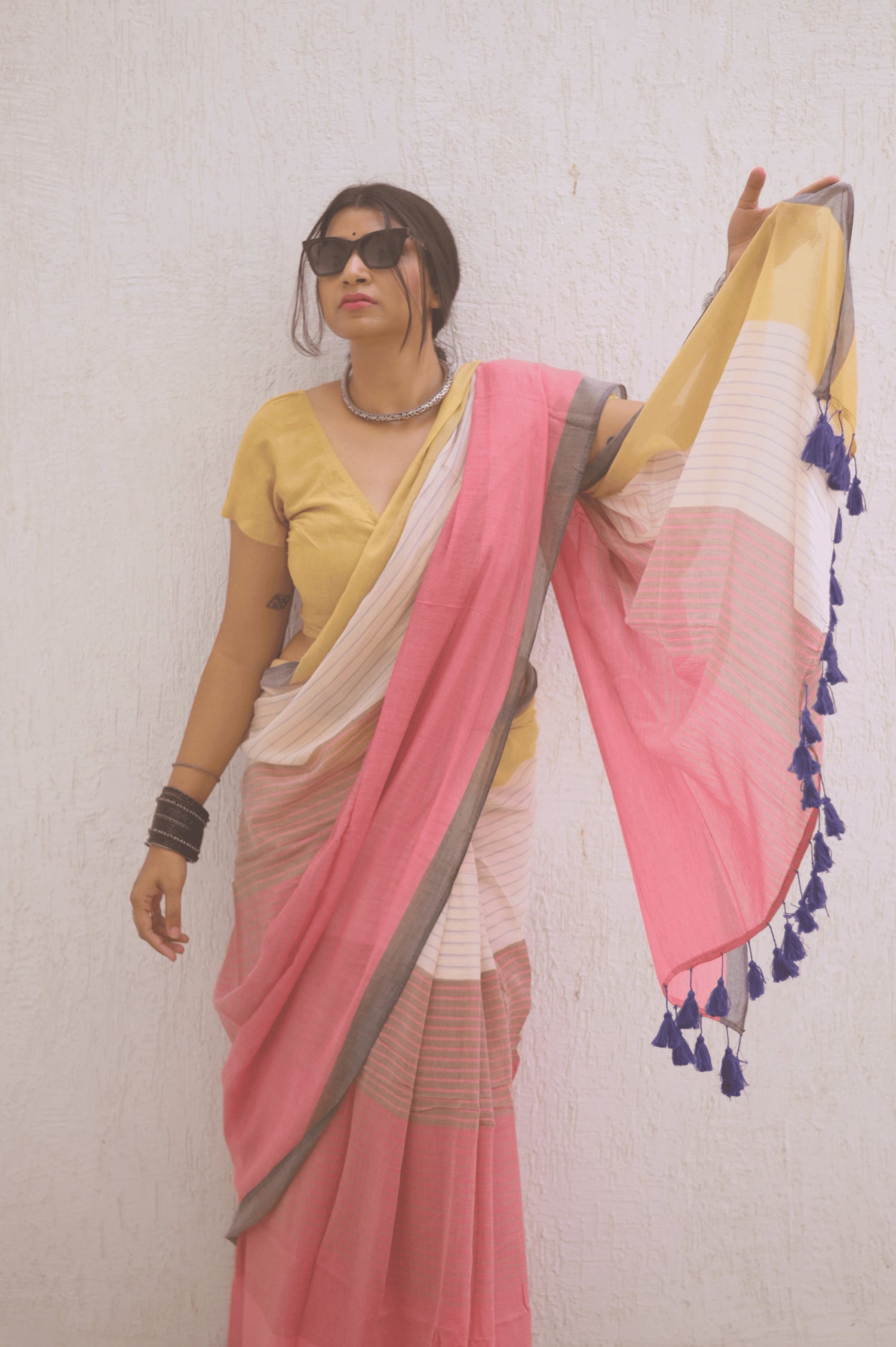
These are lighter sarees for the functions around the wedding: aiburobhat, the days after, the reception and the women of the family. Every MAYIN saree is 5.5 m long and 45 inches wide. Lilac Bloom is a lavender floral jamdani with no blouse piece, a gentle aiburobhat choice. On Repeat and Main Event are pure handloom linen with zari borders and a 1 m blouse piece, at ₹4,499. Bright Side is a white mul cotton with a yellow border that takes a gentle cold hand wash, useful for gaye holud or for relatives on the wedding morning. For the reception, Ruby and Starlet are pure chiffon with sequins and a 1 m crepe blouse piece. All except Bright Side are dry clean only. Delivery is free in India on orders of ₹2,000 and above.
 Lilac BloomLavender floral original dhakai jamdaniPair with Gold, white
 On RepeatYellow handloom linen with zari borderPair with Red, gold
 Bright SideWhite mulmul cotton with yellow borderPair with Yellow, red
 Main EventBurgundy red pure handloom linen with zari borderPair with Gold, cream
 Miss Earth Tissue SareeMiss earth tissuePair with Maroon, gold
 RubyRed gold sequin pure chiffonPair with Gold, red
 StarletWine sequin pure chiffonPair with Gold, blush pink
 MidasResin gold sequin pure chiffonPair with Maroon, gold
Questions People Ask
Which saree is worn by a Bengali bride?
For the wedding itself, usually a red Banarasi silk with gold or silver zari. Lighter sarees are worn for aiburobhat and gaye holud, and a second silk for bou bhaat and the reception.
Why do Bengali brides wear a red Banarasi?
Red is the auspicious colour of a Bengali wedding, and the Banarasi has long been the saree a Bengali trousseau is built around. Many families pass one wedding Banarasi from mother to daughter.
What should I wear for my aiburobhat?
A light handloom such as a tant, a Dhakai jamdani or a soft silk, in yellow, orange, pink or green. You will sit on the floor and eat by hand, so keep the jewellery light and the sleeves short.
What colour saree is worn for gaye holud?
Usually yellow, or white or yellow with a red border, in cotton. The saree often comes from the groom’s family in the tattwa, along with the turmeric paste.
Who gives the shakha pola to the bride?
The bride’s mother usually presents the set, and married women of the family put the bangles on her wrists, often at dodhi mangal on the wedding morning. Customs vary between families.
What is the difference between topor and mukut?
The topor is the groom’s tall conical headdress; the mukut is the bride’s tiara shaped crown. Both are made of white shola pith.
What is chandan design on a Bengali bride?
Fine patterns in white sandalwood paste drawn above the eyebrows and across the forehead, often onto the cheeks, framing a red bindi. Paisleys, arches, vines and dots are the usual motifs.
What does a Bengali bride wear for bou bhaat?
Usually a second silk such as a lighter Banarasi, a jamdani or a Baluchari, often not in red. She wears it with her sindoor, shakha pola and loha.
Can a Bengali bride wear a colour other than red?
Yes. Maroon, pink, white and gold, and red bordered garad or korial are all worn, and some families prefer white. Ask whether your family has a custom first.
How much does a Bengali bridal Banarasi cost?
As of 2026, often roughly ₹15,000 to ₹50,000 for a handloom pure katan with tested zari, less for powerloom and far more for real gilt zari. Prices vary widely by city and shop.
Is a Banarasi too heavy to wear all night?
A dense all-over jaal with real zari can feel heavy. Try it draped for fifteen minutes, and consider a body with scattered buttas and a strong border, which is lighter.
Can a Bengali bride wear a lehenga for the reception?
Many do. The reception is the most flexible function, though the shakha pola, loha and sindoor usually stay on.

