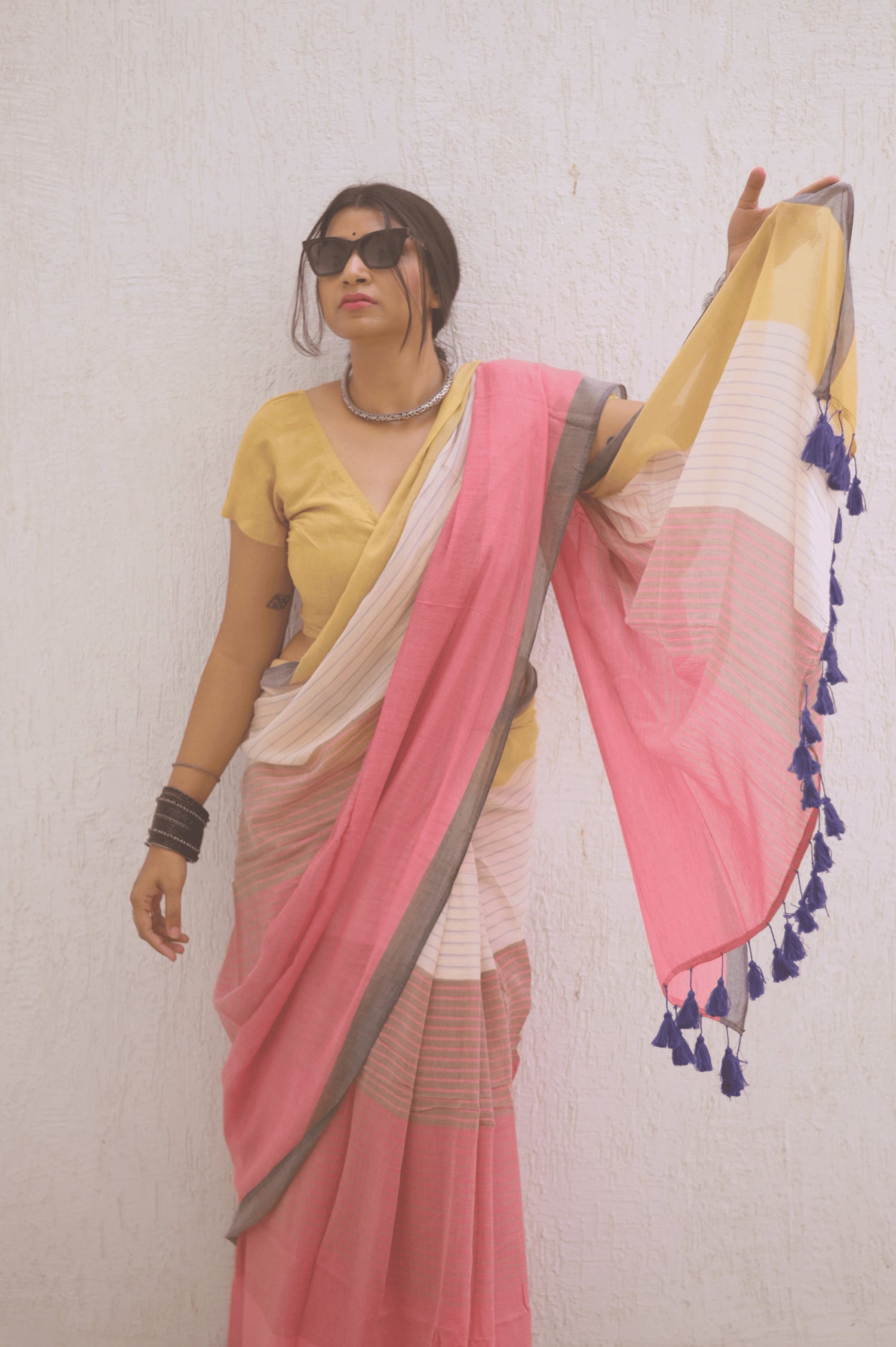


Advocate Saree: What Women Lawyers Can Wear to Court, and How to Wear It

Yes, a woman advocate in India may wear a saree to court. Under the Bar Council of India rules, the saree should be white, black or any mellow or subdued colour without any print or design, worn with a black coat and white bands, and with the advocate's gown when you appear in the Supreme Court or a High Court. This guide sets out what the rules actually say, where local practice adds to them, and then the practical part: which fabric survives a day under a black coat, how to cut the blouse, how to pin the drape so it stays put through hearings, and how to keep a small set of court sarees in good order.
What the Bar Council Rules Say
Dress for advocates is set by the Bar Council of India Rules, Part VI, Chapter IV. The rules apply to advocates appearing in the Supreme Court, High Courts, subordinate courts, tribunals and authorities. For women they give two routes. You may follow either one.
The saree sits in route (b). Read the colour words carefully: white, black, or mellow or subdued, and without any print or design. The rule does not list colours beyond that, so "subdued" is a judgement each court and each judge makes. That is why practice varies between a district court in one state and a High Court in another.
The rules quoted here are as circulated by the Delhi High Court in its notice of 28 February 2018, and the same wording appears in the Kerala High Court's 2015 judgment upholding the dress code. State bar councils and High Courts can and do issue their own notices on top, most often summer relaxations. If you are new to a court, ask the bar association office or a senior in chambers what is expected there.
Coat, Gown and Bands: When Each Is Needed
Three pieces sit over the saree: the black coat, the white bands at the throat and the advocate's gown. Which ones you need depends on the court and, in some months, the weather.
The summer rule reads: except in the Supreme Court and High Courts, during summer the black coat is not mandatory. The rules do not fix the months. Courts and bar associations notify them, usually each year. In 2024, for example, the Kerala High Court made the gown optional in the High Court and both coat and gown optional in the district courts until 31 May. Keep the coat in your bag even on exempt days, in case you are called before a bench that expects it.
What the bands are
Bands are the two short white strips that hang from the front of the collar. Many women advocates wear them on a separate white band collar that ties or hooks at the back of the neck, so they work over any blouse neckline. Under route (b) you do not need a collared shirt: the band collar sits on the blouse or directly at the neck. Keep two sets, as they mark with sweat and need washing more often than the coat.
Which Saree Colours Work in Court
White and black are always safe. Beyond those, think of colours that would look quiet next to a black coat: greys, creams, soft pastels and muted, greyed tones. Bright, saturated colours and anything with a print, a woven pattern or a contrast border is where you start relying on a judge's goodwill.
Two practical points. A black coat over a white or pale saree shows every fleck of dust and lint, so a pale saree needs a clean, brushed coat. And a black saree under a black coat reads as one block of colour, which many advocates like for exactly that reason: nothing to judge, nothing to worry about. If you are building a set from scratch, start with one black and one white, then add one subdued colour. For more on wearing a black saree well, see our black saree look guide, and for white, the white saree look guide.
Fabric for a Long Day Under a Black Coat
A court day often means early travel, a crowded corridor, long waits and a coat that rarely comes off. The saree under it needs to breathe, survive sitting for hours and look tidy at four in the afternoon. A light cotton is the usual answer, and it is what most advocates reach for.
Mul cotton and mul modal are both soft, fine weaves that sit flat under a coat and do not add bulk at the waist. The difference between them is mostly in hand feel and how they recover from sitting; our mul cotton vs mul modal guide goes through it. A crisp starched cotton gives a sharper outline, which some advocates prefer for important hearings; if that is you, see how to starch a cotton saree.
Avoid heavy weaves, zari and anything with a raised surface. Under a coat they add weight and heat, they snag on the coat lining, and most of them fall outside "without any print or design" anyway.
The Blouse Under a Black Coat
The blouse is the part that touches the coat lining all day, so cut it for comfort first. The rules do not name a blouse colour for a saree, but a white or black blouse, or one in the saree colour, keeps the look plain. A matching blouse cut from a running blouse piece is the simplest option.
For full measuring steps see the blouse measurement and fitting guide. Some advocates keep a stitched black and a stitched white blouse that go with every saree in the set; that is often more practical than one blouse per saree.
Drape, Pleats and Pinning for Court
The nivi drape is standard for court: tucked at the waist, pleats at the navel facing left, pallu over the left shoulder. What changes for court is the pallu. It has to sit under the coat, or be pinned so flat that the coat closes over it, and it must not slip when you stand up to address the bench.

For the pleats themselves, including how wide to make them in each fabric, see how to make saree pleats. For mul cotton in particular, which is soft and can slide, our guide to draping a mul cotton saree has extra pinning tips.

Fitting the Black Coat Over a Saree
An advocate's coat worn over a saree needs a slightly different fit from one worn over a shirt. The pallu adds a layer over the left shoulder and chest, and the pleats add a little at the front of the waist. A coat bought or stitched for trousers can feel tight in exactly those places.

For more on wearing a jacket or blazer over a saree outside court, see our saree with jacket guide.
Footwear, Petticoat and What to Carry
Court days involve corridors, stairs and standing in line, so set the saree hem for the shoes you will actually walk in. Low block heels, flat sandals or closed flats in black, brown or tan are the usual choice. Put them on before you drape, and keep the hem just clear of the floor, about half an inch above the top of the sole, so it does not catch on steps.
Wear a cotton petticoat in the saree colour, or white under white and black under black. A petticoat that shows a different colour through a fine mul is easy to notice under court lights. Our saree petticoat guide covers sizes and fit.
A Small Court-Day Saree Wardrobe
You do not need many sarees for court. Because the coat covers most of the look, five or six sarees in rotation are enough for a working week, with one in the wash and one spare. The point is that every one of them is plain, comfortable and works with the same blouses.
Keep sarees with prints, borders or checks for days in chambers, client meetings or the office. For a general office saree wardrobe, which has more room for colour and pattern, see how to look professional in a saree. For a first interview at a firm, see the formal saree for interview guide. You can browse plain options in our plain sarees and black sarees collections.
Caring for Court Sarees
Court sarees are worn often and in heat, so they need simple, regular care. Plain mul cotton and plain mul modal usually take a gentle cold hand wash, which suits a saree worn twice a week.
Brush the coat after every court day and air it overnight before it goes back on the hanger. For fabric-by-fabric washing instructions, see how to wash cotton, chiffon and linen sarees, and for keeping creases down between washes, our crease-free saree care guide.
Sarees in This Guide
These MAYIN sarees fit a court wardrobe or the days around it. Each is 5.5 m long and 45 inches wide. After Dark, the plain black mul cotton, is the closest to a standard advocate saree. Lilac Blush, Dusty Rose and Mauve Melody are plain, soft colours for courts where subdued shades are accepted; Dusty Rose and Mauve Melody come with a 1 m running blouse piece in the same fabric. Bright Side has a yellow border and Spot On a polka dot print, so keep those for chambers, client meetings and office days rather than court. Free delivery in India on orders of ₹2,000 and above.
 After DarkPlain black mul cottonPair with White, black
 Lilac BlushPlain purple mulPair with White, black, grey
 Dusty RosePlain peach mul modalPair with White, black, cream
 Mauve MelodyPlain pink mul modalPair with White, black, grey
 Bright SideWhite mulmul cotton with yellow borderPair with White, yellow
 Spot OnCharcoal polka dot mulmul cottonPair with White, black, grey
After Dark and Lilac Blush are ₹1,699, Dusty Rose and Mauve Melody ₹1,899, Bright Side ₹1,999 and Spot On ₹2,499. All six take a gentle cold hand wash. More choices are in our office wear sarees collection.
Questions People Ask
What is the dress code for female lawyers in India?
Under the Bar Council of India rules, women advocates may wear a black jacket or blouse with a white collar, bands and gown, or a white blouse with bands and a black open-breasted coat. They may also wear a saree, long skirt, flares, salwar-kurta or churidar-kurta, or traditional dress, with a black coat and bands.
Can a lady advocate wear a saree in court?
Yes. The rules allow sarees in white, black or any mellow or subdued colour without any print or design, worn with a black coat and bands, and with the gown in the Supreme Court and High Courts.
Which colour saree can an advocate wear?
White and black are always accepted. Mellow or subdued colours such as grey, cream and soft pastels are allowed by the rules, but what counts as subdued is a judgement call, so check practice in your court.
Can a woman lawyer wear a printed saree in court?
The rule says without any print or design, so a printed, checked or patterned saree is not within it. Keep those for chambers and office days.
Is the gown compulsory for women advocates?
The gown is required when appearing in the Supreme Court or a High Court and is optional in other courts. High Courts sometimes make it optional in summer by notice.
Do lawyers have to wear the black coat in summer?
Except in the Supreme Court and High Courts, the black coat is not mandatory during summer. The summer months are notified by courts and bar associations, so check the current notice.
What colour blouse should I wear with an advocate saree?
The rules do not name a blouse colour for a saree. White, black or the saree colour keeps the look plain, and an elbow-length sleeve is most comfortable under a coat.
Which saree fabric is best for lawyers in summer?
A light, breathable cotton such as mul cotton or mul modal is usually most comfortable under a black coat. Avoid heavy weaves and synthetics, which trap heat.
Can women advocates wear salwar kurta in court?
Yes. The rules allow churidar-kurta or salwar-kurta, with or without dupatta, in white or black, with a black coat and bands.
What are advocate bands?
Bands are the two short white strips worn at the throat. Women often wear them on a separate band collar that ties or hooks at the back, over the blouse.
How do I keep my pallu in place under the coat?
Pleat the pallu narrowly, keep it a little shorter, pin it to the blouse at the left shoulder from underneath, and add a second pin at the left waist.


